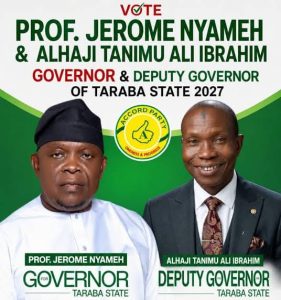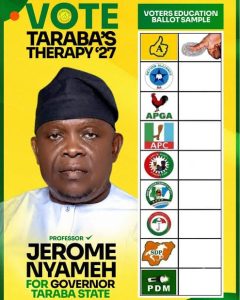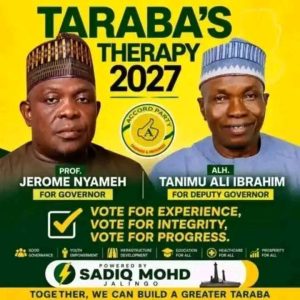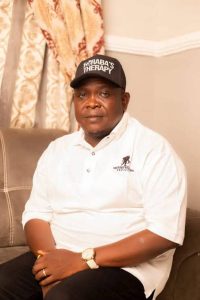


Accord governorship aspirant promises economic revival, job creation, improved security and accountable governance ahead of 2027 election
By Iranyang Daniel
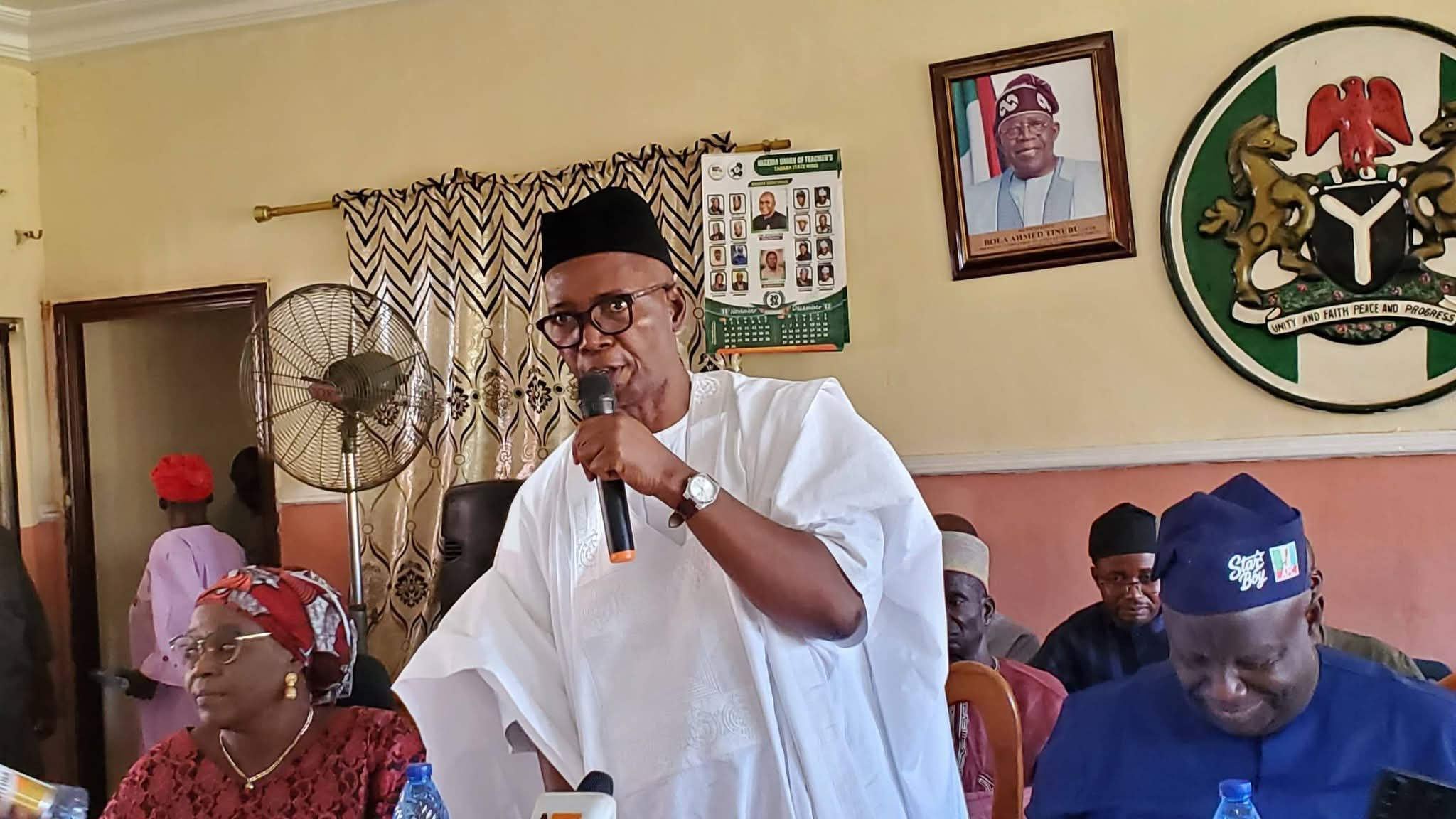
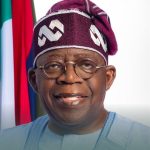
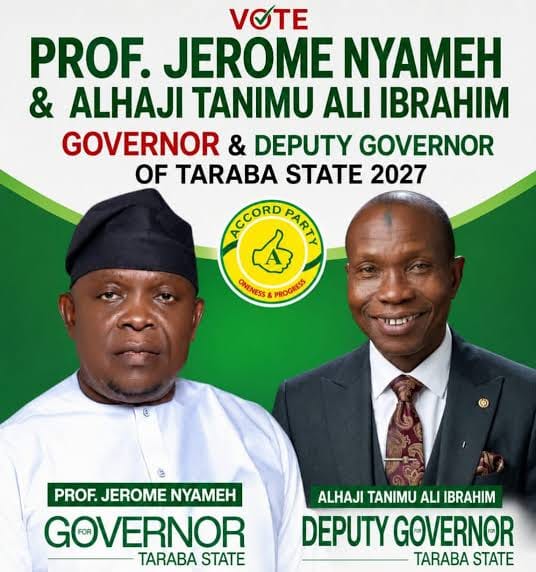
The Accord Party governorship aspirant in Taraba State, Professor Jerome Nyameh, popularly known as the People’s Professor, has unveiled an ambitious development blueprint tagged “Taraba Therapy,” promising to rebuild the state through agricultural transformation, industrialisation, improved public services and transparent governance.
Nyameh made the disclosure on Today’s Politics, a SUM TV programme anchored by Iranyang Daniel on Monday, October 12, 2026, where he outlined his vision for addressing the state’s economic, social and institutional challenges ahead of the 2027 governorship election.
He argued that Taraba needs purposeful leadership, stronger public institutions and practical policies capable of unlocking its vast agricultural, mineral and human resources.
His proposed seven-point agenda focuses on trade and industry, healthcare, education, recovery and security, agribusiness, prosperity and youth empowerment.
Agriculture and Industrialisation
Nyameh identified agriculture as a major driver of economic recovery, proposing the establishment of agricultural zones and cooperatives along major exit routes to purchase farm produce and connect farmers with markets outside the state.
He also proposed cultivating up to 500 hectares in locations including Bali, Gashaka and Karim Lamido, with government support for seeds, fertilisers, technical consultants and young farm managers.
Under the proposed arrangement, beneficiaries would repay the support through a portion of their harvest, while government-backed purchasing arrangements and off-takers would help guarantee markets for agricultural produce.
The aspirant further advocated the development of a dam at Shagada in Gashaka to support dry-season vegetable farming, alongside the exploration of small dams and turbine systems for local electricity generation.
He maintained that reliable electricity, water supply and security were essential to industrial development, business expansion and employment generation.
Nyameh also called for agricultural mechanisation to reflect local soil conditions and farming needs, questioning the suitability and productive use of some tractors supplied to farmers.
Education and Healthcare
On education, Nyameh questioned the description of reduced tuition fees as free education, insisting that government policies should clearly define their scope and demonstrate measurable benefits for students and their families.
He stressed the importance of recruiting adequate teachers and lecturers, improving teaching standards and ensuring that education policies translate into better learning outcomes.
For healthcare, he proposed expanding access to medical services across Taraba’s 168 wards, with the aim of making healthcare more accessible to residents in both urban and rural communities.
He maintained that education and healthcare should be treated as essential public services supported by adequate planning, funding and effective implementation.
Security and Traditional Institutions
On security, the Accord aspirant advocated greater involvement of traditional rulers and community leaders in intelligence gathering, early warning systems and conflict prevention.
He argued that traditional institutions possess valuable knowledge of their communities and should be better supported to contribute to peacebuilding and the protection of lives and property.
While acknowledging government efforts to address insecurity, Nyameh called for a more visible response to security incidents and stronger community-level participation in maintaining peace.
Transparency and Management of Public Resources
Nyameh pledged to make accountability a central feature of his proposed administration, advocating budgets that clearly identify projects, costs and funding sources.
He proposed regular public reports detailing project implementation, completed activities and how public funds are spent.
He also called for transparent procurement procedures that would allow qualified local contractors to compete fairly for government projects.
On solid minerals, he demanded greater clarity regarding mining operations, land allocations, contractual arrangements and the revenue accruing to the state.
He proposed a three-pronged approach to public resource management: recovery, improved utilisation and renegotiation of unfavourable arrangements. He also advocated partnerships with mining operators to increase the economic benefits accruing to Taraba.
First 100 Days and Youth Empowerment
Outlining his expectations for the first 100 days of a possible administration, Nyameh promised visible efforts to improve governance, strengthen public institutions and promote economic productivity.
He proposed encouraging higher institutions to establish income-generating ventures to supplement conventional funding for salaries and operational expenses.
For young people, he promised an entrepreneurial approach focused on business development, skills acquisition, job creation and productive participation in the state’s economy.
He also pledged to promote a civil service built on professionalism, transparency and accountability, arguing that effective governance depends on institutions capable of translating policies into results.
His prosperity agenda would also address workers’ welfare, working conditions, public facilities and housing.
Defends Choice of Running Mate
Nyameh defended his choice of running mate, Prince Tanimu Ibrahim Ali, citing his royal heritage in Takum, experience in local government administration and former leadership of the Nigeria Union of Local Government Employees (NULGE) in Taraba State.
Ali, who rose to become Director of Budget and Planning within the local government system, brings public service experience, labour leadership and community connections to the political ticket.
Nyameh explained that Ali emerged through a selection process involving the community designated to produce the deputy governorship candidate. He said he met his running mate for the first time after the selection but maintained that his suitability should be judged by his experience, background and capacity to contribute to the political project.
From PDP to Accord
Explaining his political journey, Nyameh said he left the Peoples Democratic Party, which he had belonged to since 1998, following advice from supporters amid internal disputes and uncertainty surrounding court cases involving rival factions.
He said he initially resisted joining another party but eventually aligned with Accord after its convention in Abuja.
According to him, the party’s leadership and philosophy of “oneness and progress” influenced his decision.
His emergence as a governorship aspirant places his proposed development agenda at the centre of political discussions ahead of the 2027 election.
Appeal to Taraba Residents
In his closing remarks, Nyameh appealed to farmers, civil servants, women, vulnerable groups and other residents to support the Accord Party in the forthcoming election.
He presented Taraba Therapy as his proposed response to what he described as years of political divisions, weakened institutions and missed economic opportunities.
However, the success of the blueprint would depend on its funding arrangements, implementation strategy and the ability of a future administration to deliver measurable results.
As the 2027 governorship contest approaches, Nyameh’s proposals on agriculture, industrialisation, security, education and accountability are likely to face scrutiny from voters seeking practical solutions to Taraba State’s development challenges.