









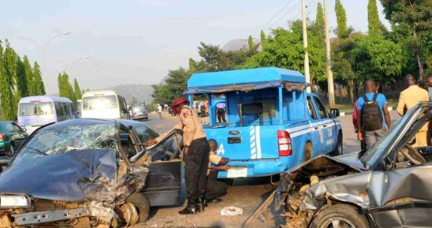
The Federal Road Safety Corps (FRSC), Taraba State Sector Command, has disclosed that 72 people lost their lives, while 374 others sustained various degrees of injuries in 115 road traffic crashes recorded across the state between January and October 2026.
The Sector Commander, Corps Commander (CC) Anna Attah, made this disclosure on Thursday during a press briefing with critical stakeholders at the Nigeria Union of Journalists (NUJ) Press Centre in Jalingo, as part of activities commemorating the 2026 World Day of Remembrance for Road Traffic Victims.
Attah described the statistics as a disturbing reminder of the devastating consequences of road traffic crashes, calling for renewed commitment from government institutions, transport operators, motorists, passengers and other road users to address the persistent challenge of road accidents.
She said this year’s commemoration, themed “A Light that Unites Us,” with the global message “Remember, Support, Act,” was designed to honour victims of road traffic crashes, recognise the struggles of survivors and encourage collective action towards preventing avoidable road tragedies.
According to her, the remembrance week goes beyond a ceremonial observance, as it provides an opportunity for society to reflect on the human cost of road crashes and the lasting effects on families, communities and survivors.
She emphasised that behind every road traffic crash statistic is a human being, noting that every life lost represents a shattered dream, a grieving family and a future cut short.
The Sector Commander observed that many survivors of road crashes continue to endure physical disabilities, psychological trauma, emotional distress and financial difficulties long after the incidents, making road safety a critical public health and development concern.
She questioned the continued loss of lives on Nigerian roads despite the fact that many crashes could be prevented through responsible driving, strict compliance with traffic regulations and improved road safety awareness.
Providing a global perspective, Attah disclosed that more than 50 million people had lost their lives in road traffic crashes since the first recorded road fatality, while hundreds of millions had sustained various degrees of injuries.
She noted that the alarming global situation, particularly its impact on children and young people, informed the United Nations Decade of Action for Road Safety 2021–2030, which seeks to achieve a 50 per cent reduction in road traffic deaths and injuries by 2030.
Presenting Nigeria’s road traffic crash statistics, the FRSC Sector Commander revealed that the country recorded 10,617 crashes in 2023, resulting in 5,081 deaths and 31,874 injuries.
She explained that although the number of crashes declined to 9,570 in 2024, representing a 10 per cent reduction, fatalities increased by seven per cent to 5,421, while 31,154 people sustained injuries.
Similarly, Nigeria recorded 10,446 road traffic crashes in 2025, claiming 5,289 lives and leaving 33,400 persons injured.
She further disclosed that between January and September 2026, the country recorded 7,156 crashes, resulting in 3,445 deaths and 22,292 injuries.
Attah stressed that the figures were not merely statistical records but represented human tragedies, broken families and communities struggling with the consequences of preventable road accidents.
Identifying the major causes of road traffic crashes, she listed excessive speeding, dangerous overtaking, distracted driving, driving under the influence of alcohol or drugs, overloading, driver fatigue, poor vehicle maintenance and disregard for traffic signs and signals.
She maintained that road crashes were often associated with human errors, negligence and deliberate violations of traffic regulations, warning that reckless decisions by motorists could result in irreversible consequences.
The Sector Commander therefore called for a comprehensive and collective approach to road safety, urging government agencies to strengthen road safety policies, improve enforcement and support initiatives aimed at creating safer roads.
She also challenged transport operators to prioritise the safety of passengers over financial gains, while urging drivers to demonstrate discipline, patience and responsibility whenever they were behind the steering wheel.
Passengers and pedestrians, she added, must equally understand their responsibilities by observing traffic regulations and avoiding actions that could endanger their lives and those of other road users.
Reaffirming the commitment of the FRSC to its statutory mandate of reducing road traffic crashes and creating safer motoring environments, Attah said the Corps would continue to intensify efforts towards protecting lives and property across the country.
However, she emphasised that enforcement alone could not guarantee safer roads without a corresponding change in the attitudes and behaviour of motorists and other road users.
“Enforcement alone cannot guarantee safety. We need a change of attitude, a change of behaviour and a collective commitment to responsible road use,” she stressed.
Explaining the significance of this year’s global message, “Remember, Support, Act,” Attah said the three words represented the fundamental responsibilities required to address the consequences of road traffic crashes.
She explained that remembering means honouring those who lost their lives and preserving their memories; supporting involves extending care, assistance and encouragement to crash survivors, bereaved families and other affected persons; while acting requires motorists and other road users to make responsible choices, obey traffic regulations and advocate safer roads.
She also acknowledged the sacrifices and dedication of first responders, FRSC personnel, medical professionals, emergency rescue teams and other stakeholders who work tirelessly to rescue victims, provide emergency medical assistance and save lives during road emergencies.
The Sector Commander urged motorists to abandon reckless driving practices and cultivate a culture of patience, caution and mutual respect on the highways.
She cautioned that vehicles should never be treated as weapons and highways should not be turned into racing tracks, stressing that arriving safely at one’s destination was more important than driving at excessive speeds.
“Let every driver remember that the vehicle is not a weapon, the highway is not a racetrack, and it is better to arrive safely late than to be late,” she advised.
Attah further called on all road users to make personal commitments towards protecting lives, respecting other motorists and ensuring that families were not subjected to the avoidable pain of losing loved ones through road traffic crashes.
She reiterated that the central message of the remembrance week remained the need to honour victims, support survivors and take practical steps to prevent future tragedies.
The Sector Commander also expressed appreciation to the Taraba State Government under the leadership of Governor Agbu Kefas and members of the State Executive Council for their logistical support to the FRSC Sector Command in its efforts to ensure the safety of lives and property across the state.
She noted that sustained collaboration between the government, security agencies, transport stakeholders and the general public remained essential to achieving safer roads and reducing road traffic fatalities in Taraba State.
Attah, urged residents of the state and Nigerians at large to embrace responsible road use, emphasising that every life matters, every journey counts and every road user deserves to arrive alive.