







TSU, UTM, ABU, Makerere Forge New African Alliance for Future-Ready Education
Taraba State University (TSU), Jalingo, has joined forces with leading African and international institutions to advance collaboration, innovation and transformative education through the 2026 International Colloquium on Future-Ready and Transformative Education (ICOFTE 2026).
The virtual international colloquium, held on Wednesday, August 12, 2026, was organised by the Faculty of Educational Sciences and Technology of Universiti Teknologi Malaysia (UTM), bringing together academics, researchers and education experts from TSU, UTM, Ahmadu Bello University (ABU), Zaria, and Makerere University, Kampala, Uganda.
Held under the theme “Future-Ready and Transformative Education,” the event focused on emerging technologies, research, innovation and strategies for repositioning higher education to meet rapidly changing global challenges.
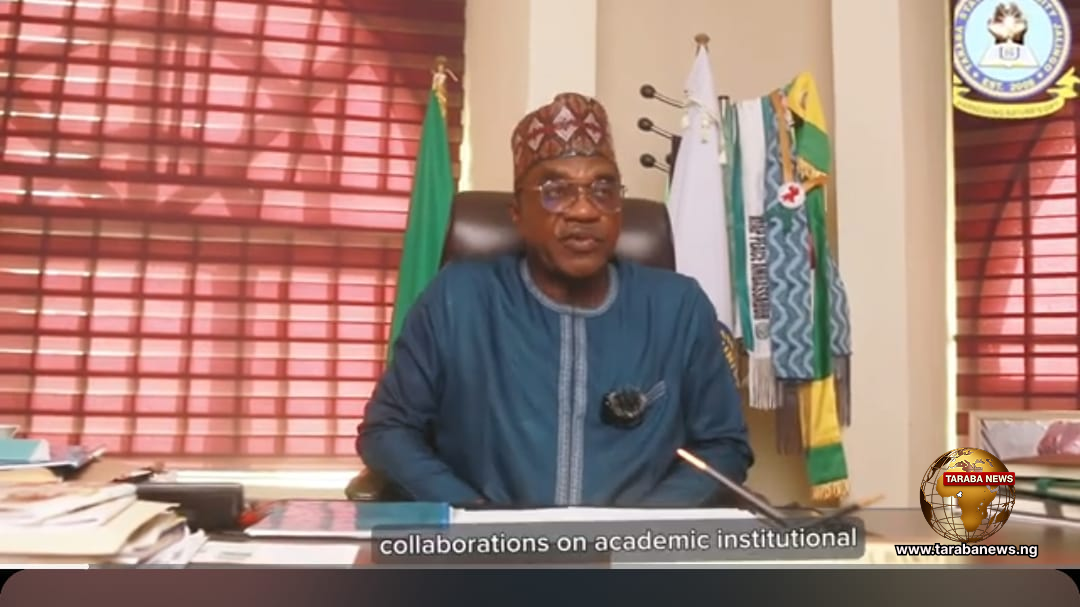
A major highlight was the participation of the Vice-Chancellor of Taraba State University, Prof. Sunday Paul Bako, who delivered a keynote address titled “Values-Based Higher Education for Future-Ready Societies.”
Prof. Bako used the platform to advocate stronger partnerships among African universities, stressing the need for institutions across the continent to move beyond isolated collaborations and establish a sustainable knowledge alliance capable of driving research, innovation and meaningful societal transformation.
Speaking on “From a Bilateral Milestone to an African Knowledge Alliance,” the Vice-Chancellor described the relationship between TSU and UTM as an important milestone in the university’s growing international academic engagement.
He explained that the partnership evolved from academic discussions and consultations into mutual trust, institutional commitment and the eventual signing of a formal Letter of Collaboration.
According to him, the agreement provides opportunities for joint research, faculty and student exchanges, joint postgraduate supervision, academic conferences, webinars, workshops, exchange of scholarly materials and community engagement.
Prof. Bako, however, emphasised that the ultimate success of such partnerships should be measured by their tangible impact on students, academics and communities.
Bako Proposes African Education Consortium
The involvement of ABU and Makerere University, he noted, has transformed the initial TSU-UTM bilateral relationship into a broader platform for African academic cooperation.
Against this backdrop, the Vice-Chancellor proposed the establishment of an African Consortium for Future-Ready and Transformative Education, initially comprising TSU, UTM, ABU and Makerere University, with opportunities for other institutions to join.
He identified key areas for collaboration to include multidisciplinary research, joint postgraduate supervision, academic mentorship, curriculum development, collaborative publications, competitive research grants and innovation exchange.
Prof. Bako also called for the institutionalisation of an annual ICOFTE programme, alongside the creation of thematic research clusters focusing on emerging and critical areas such as artificial intelligence and education, values-based curriculum, teacher development, quality assurance, sustainability and educational leadership.
He urged the participating institutions to ensure that the ideas and recommendations generated at ICOFTE translate into practical programmes and measurable outcomes rather than remaining merely as conference resolutions.
TSU Scholars Take Centre Stage
Taraba State University also featured prominently in the academic sessions, with several of its scholars serving as keynote speakers, lead paper presenters and moderators.
Among them was Prof. Mustapha Abdulrazaq Baba Ibi, who delivered a lead paper titled “Translating Institutional Vision into Curriculum, Teaching, Research and Community Impact.”
His presentation emphasised the importance of connecting institutional vision with curriculum development, teaching, research and community engagement to ensure that universities remain responsive to societal needs.
Other notable speakers included Prof. Dr. Hamdan Said of UTM, who examined digital transformation, university leadership and global partnerships; and Prof. Adamu Ahmad, Vice-Chancellor of Ahmadu Bello University, who presented a paper on research leadership, quality assurance and curriculum transformation in African universities.
Prof. Abdullahi Dalhatu of ABU presented a lead paper on strengthening academic excellence through innovation, ethics and partnership, while Dr. Murtala Aminu-Baba of Makerere University addressed intelligent technologies, university transformation and Africa’s global relevance.
The programme also featured academics from the participating institutions as moderators, including Prof. Baba Ahmed, Deputy Vice-Chancellor, Academic and Research, TSU; Prof. Dr. M-Al-Muz-Zammil Yasin of UTM; Prof. Dr. Abdul Anakebe Isa of Makerere University; Prof. Solomon I. Ahmadu of TSU; Dr. Yap Soon Li of UTM; and Dr. Sabo Jamilu of ABU.
The organisers said ICOFTE 2026 was designed to deepen academic collaboration, facilitate knowledge exchange and promote innovative approaches to curriculum development, teaching, research and community impact.
The expanded participation of Taraba State University in the international forum further highlights the institution’s growing global academic partnerships and its drive to strengthen research excellence, innovation and transformative education.
The emerging collaboration among TSU, UTM, ABU and Makerere University could therefore provide a stronger platform for African institutions to jointly develop solutions to the continent’s educational challenges while preparing students and academics for the demands of the future.