





Accord candidate says Adeleke’s victory has opened a new political conversation ahead of Taraba governorship election
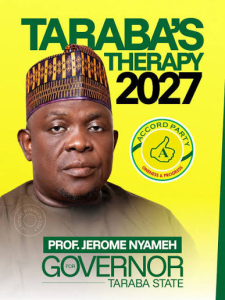
The outcome of the Osun State governorship election has begun to reverberate beyond the state, with Accord Party governorship candidate in Taraba State, Professor Jerome Nyame, describing Governor Ademola Adeleke’s victory as a political signal that could inspire voters across the country ahead of the 2027 elections.
Nyame, in a congratulatory message issued on Sunday, said Adeleke’s re-election had demonstrated the power of voters to determine electoral outcomes irrespective of the political strength behind competing candidates.
For Taraba, where political realignments have intensified ahead of 2027, Nyame believes the Osun experience offers an important lesson.
According to him, the election has provided renewed confidence to Nigerians who may have doubted the ability of opposition forces to compete successfully against candidates backed by the governing establishment.
He described Adeleke’s victory not merely as an electoral success, but as a development capable of reshaping the expectations of voters in other states.
«“It is a message of hope for the people of Taraba and indeed Nigeria at large,” Nyame said.»
The Accord candidate argued that the Osun result demonstrated what could happen when voters unite around a political choice.
His message was particularly directed at Tarabans ahead of the 2027 governorship election, urging them to draw lessons from Osun and approach the next election with confidence in the power of their votes.
A New Message for Taraba’s 2027 Contest
Nyame’s intervention comes at a time when Taraba’s political landscape is undergoing one of its most significant realignments in recent years.
The movement of Governor Agbu Kefas from the Peoples Democratic Party to the All Progressives Congress has altered the political calculations in the state, while the emergence of several opposition candidates has created a more crowded contest for the Government House in Jalingo.
With the APC now controlling the state government and enjoying a closer relationship with the Federal Government, the question of whether opposition candidates can mount an effective challenge has become central to the 2027 debate.
It is against this backdrop that Nyame’s interpretation of Osun becomes politically significant.
His argument is essentially that political strength on paper does not automatically translate into victory at the polling unit.
The Osun result, in his view, should encourage opposition parties and voters who believe that electoral competition can still produce unexpected outcomes.
‘Federal Might’ and the Taraba Question
One of the strongest political messages in Nyame’s statement was his assertion that the Osun election had broken what he described as the “myth of the federal might and ruling party.”
That argument could become increasingly prominent in Taraba’s 2027 campaign.
Governor Kefas’s decision to join the APC has been presented by supporters as an opportunity to strengthen the state’s relationship with Abuja and attract greater federal attention to development.
Opposition politicians, however, are likely to frame the same development differently.
For them, the 2027 election could become a test of whether federal alignment is enough to guarantee political victory.
Nyame’s reference to Osun provides the opposition with a ready-made political argument: that voters can still determine the outcome even when one side appears to possess greater institutional and political advantages.
The Bigger Lesson From Osun
Beyond Taraba, Nyame’s statement reflects a broader debate emerging from the Osun election.
Can an opposition candidate retain power in a state despite the strength of the ruling political establishment?
Can voters resist political pressure and make independent choices?
And can an incumbent’s performance overcome the advantages enjoyed by a rival backed by a stronger national political structure?
For Nyame, the answer from Osun is clear.
The electorate remains the ultimate political force.
He therefore urged Tarabans to approach the 2027 election with the same determination he believes was demonstrated by voters in Osun.
“If the people of Osun can do it, then the people of Taraba State can do it as well,” he said.
A Challenge to Taraba’s Opposition
The message also places an indirect responsibility on opposition parties in Taraba.
If the Osun result is to serve as a template, opposition politicians must do more than celebrate Adeleke’s victory.
They must build the structures capable of converting voter sentiment into electoral victory.
That means stronger grassroots organisation, reconciliation among competing opposition blocs, credible candidates, effective polling-unit agents and a message that resonates beyond party loyalists.
The Osun experience may provide political inspiration, but Taraba’s political terrain has its own ethnic, religious, geographical and historical complexities.
The real test will therefore be whether opposition parties can translate the enthusiasm generated by events elsewhere into a coherent statewide campaign.
The 2027 Battle Begins Earlier
Nyame’s intervention has effectively transformed a congratulatory message into an early campaign argument.
His central proposition is straightforward: the strength of a political party or its connection to the Federal Government should not make voters believe that the outcome of an election has already been decided.
For Taraba, that message could become increasingly important as the 2027 contest develops.
The APC will point to its control of the state government and its alignment with the Federal Government as a potential advantage.
The opposition will point to the electorate and argue that the ballot remains the ultimate equaliser.
Between those two narratives lies the real battle for Taraba.
And if Nyame’s interpretation of Osun gains traction, the result may become more than a victory celebrated in Osun.
It could become a political reference point in Taraba’s own 2027 struggle for power.