

By Joshua Ocheja
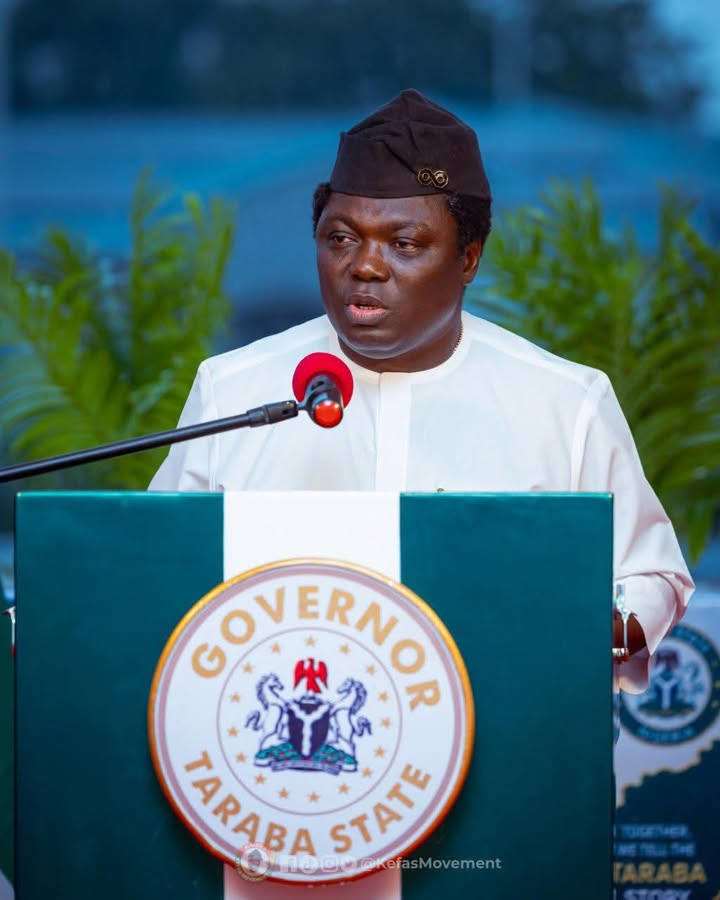
I have been to Taraba State twice and on both occasions, I left with different impressions. What caught my attention recently was the policy on compulsory free primary and secondary education in all public schools in the state, introduced two months after Governor Agbu Kefas assumed office in 2023. There was also a 50% slash in tuition in all state-owned tertiary institutions, and full government coverage of external examination fees for secondary school students.
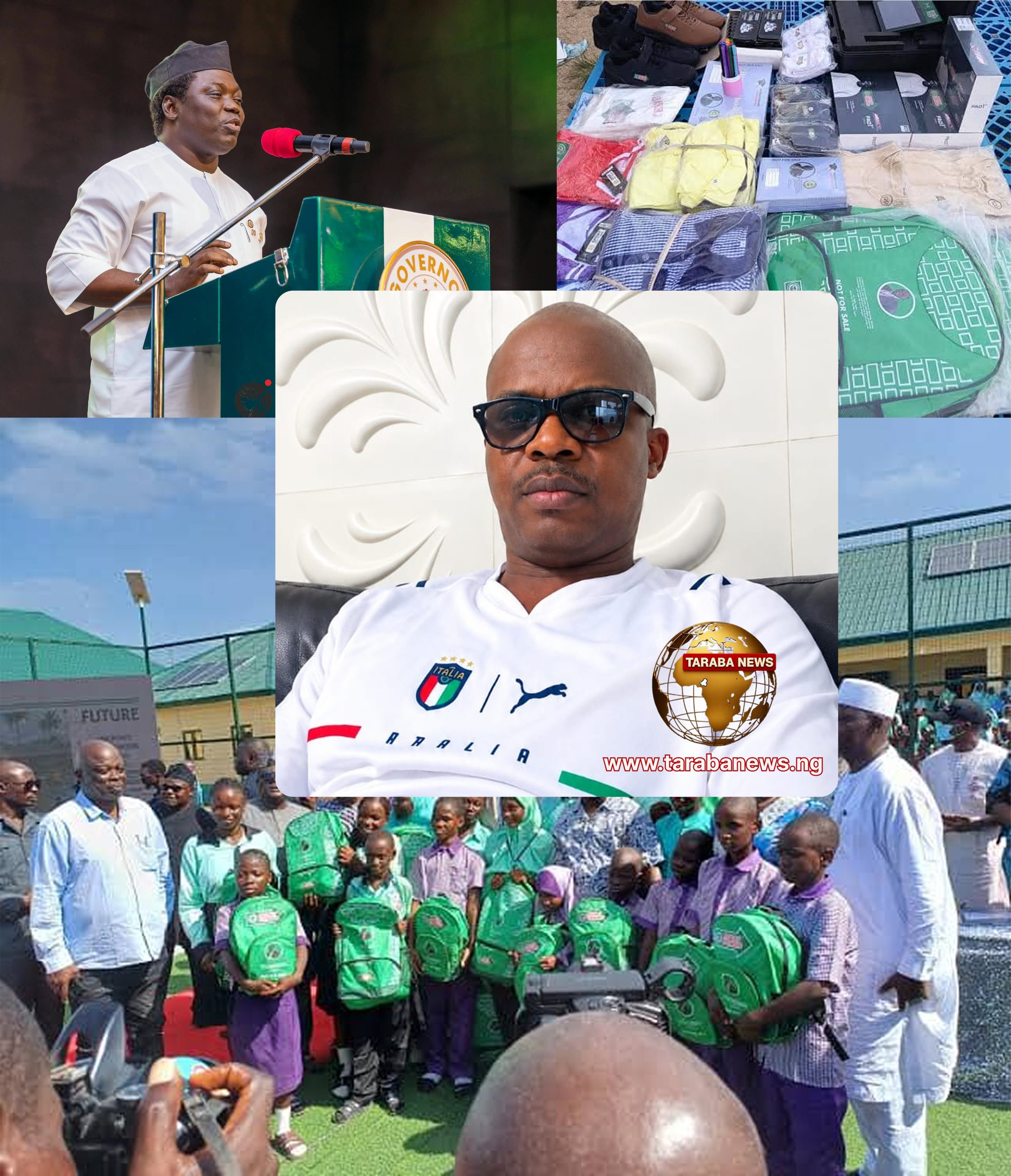
Free basic education is not new in Nigeria. It is already national policy under the Universal Basic Education Act. However, what is different in Taraba is beyond the full scholarship in public schools; pupils and students get uniforms, shoes and socks, textbooks, exercise books, and school bags free.
I spoke to Audu, a friend I have known since 2006 in Gombe during our NYSC service year, about the Taraba model. When I probed, Audu described it simply as a “total package”. He said it was unprecedented in the state’s history, and that no administration had attempted anything close to it in the 35 years since Taraba was created. He beamed as he said it. I teased him that he is from Wukari Local Government Area, like the governor. He dismissed the point, insisting it went beyond that.
The free education policy, he said, began as an “Executive Declaration” and was later backed by an Appropriation Act passed by the Taraba State House of Assembly and signed into law on 22 December 2023.
He also told me that education received the highest allocation in the state budget, ₦43.2 billion (13.9% of the total), specifically to fund tuition waivers, exam fees, and school material kits. I had some reservations with Audu’s eulogy. Audu is from Wukari and I am from Idah, so the old rivalry between the Igalas and Jukuns shapes most of our conversations, especially when we banter over whether Taraba State is doing better than Kogi State. But our banter always teaches me something, and the difference between us is that I try to document the lessons as a writer. Audu is not a writer, so I have enjoyed that privilege and advantage, which gets him uncomfortable sometimes.
In our usual manner, I refused to take Audu’s postulations on a surface level, but in fact, Taraba has done something different that is worthy of commendation. I believe Audu will be happy reading this. I don’t mind, because a fact remains a fact.
What has Taraba done differently?
The Taraba free education model covers not just tuition; it also includes the provision of books, shoes, socks, bags, and writing materials, and this has lifted much of the financial burden from the shoulders of parents whose children are enrolled in public schools in the state. For me, any policy that serves a general interest is always a welcome development. Let me add here that the introduction of this policy aimed to solve a problem because the state was in an educational crisis.
A 2018 UBEC National Personnel Audit Report put the number of out-of-school children in Taraba State at an estimated 499,923, representing 41.52% of school-aged children in the state. This created one of the most severe education access crises in the country and placed Taraba among the top five worst-affected states in Northern Nigeria.
A detailed breakdown showed a 30% out-of-school rate for primary school age (6-11) and 28.8% for secondary school age (12-15). In rural parts of the state, 38% of children were completely out of school, and 45% dropped out before finishing.
Confronted with the realities of the 2018 audit, Governor Agbu Kefas was fully justified in declaring a state of emergency in Taraba’s education sector. But unlike standard political declarations, this one yielded immediate empirical results. Information from the Taraba State Ministry of Education reveals that primary school enrolment jumped from approximately 760,000 pupils to over 1,049,000, while secondary school enrolment expanded from 100,950 to 186,235 students.
Military discipline
Governor Agbu Kefas executed this programme with what I will liken to military discipline, and the comparison is not far-fetched. He is a retired Lieutenant Colonel of the Nigerian Army and a member of the 42 Regular Course of the Nigerian Defence Academy. Military service does not automatically translate into discipline in office. Operational discipline is rare in governance, partly because the standard political lens rewards the announcement and rarely measures the follow-through.
The policy started as an Executive Declaration, which is the governor stating his intent, much as a commander would before an operation. Plenty of declarations in Nigeria end right there. This one went to the Taraba State House of Assembly, which passed an Appropriation Act that was signed into law on 22 December 2023, with ₦43.2 billion (13.9% of the budget) set aside to pay for it. The order was given, the law backed it and the money was provided, which is how a military operation is planned.
More than three years on, the bills are still being paid. In April 2026, the state released ₦1.39 billion to cover the 2026 WAEC fees of 39,536 public secondary school students. That is what I mean by discipline. It is refusing to let a stated objective drift between announcement and delivery. It is also the difference between politics and logic. Politics celebrates the announcement, while logic funds it and keeps funding it, year after year.
Human capital development
If the free educational policy in Taraba is all Governor Agbu Kefas has done since he assumed office, it cannot be said that he has done badly, as human capital is the bedrock of development, and development thrives in an atmosphere of discipline. The intention here is not to flog the concept of discipline in governance, but to state that physical infrastructure depreciates over time, whereas human capital appreciates. This is only logical.
I wish such a governance model could be embraced by elected officials whose actions and inactions beyond grandstanding are the magic wand needed to address the myriad of developmental challenges in the country. Constructing flyovers and airports is commendable, but it should be borne out of a genuine need to address a critical concern. Infrastructure and human capital are not competing necessities. But where resources are limited, governments must demonstrate that major expenditures address clearly identified public needs. A motorist can usually find another road, but the alternative to education is ignorance, and the consequences of ignorance can only be imagined.
The above is why I called Governor Agbu Kefas a “bad” guy for the audacity to introduce a policy that appeals not to the political class, but to that critical class whose hopes and aspirations depend on purposeful leadership. This is my definition of a “bad” guy, and Governor Agbu Kefas is one of the few “bad” governors in Nigeria.
This piece is intended to serve as a lesson in governance about the little things that matter most in the lives of ordinary Nigerians: education, pipe-borne water, and basic primary healthcare services, particularly in rural areas. I will not delve into other developmental necessities in the state. The education programme provides an indication of the administration’s broader approach to policy implementation, although its performance in other sectors should be judged on their own evidence.
Ocheja holds dual PhDs: Military History from the Nigerian Defence Academy, and Leadership and Public Policy from the University of Abuja. He specialises in the security-development nexus in Nigeria and the Sahel.