



From bringing dropouts back to school to tackling unemployment, the Agbu Kefas administration faces a defining test of its education policy.
By Frank Prince Garriba
Free education has become one of the flagship programmes of the administration of Governor Agbu Kefas in Taraba State. For many families struggling with the rising cost of living, the policy offers a welcome opportunity to educate their children without the financial burdens that have kept some out of school.
Yet, while the government celebrates the achievements of its education initiative, questions remain about its sustainability, the quality of education, opportunities for graduates and the broader challenges facing the state’s education sector.
At the heart of this debate is a fundamental question: can free education become a lasting investment in human capital, or will its impact be limited by the economic and institutional challenges confronting the state?
According to Dr Augustina Godwin, the Honourable Commissioner for Secondary and Vocational Education, the free education policy declared by Governor Kefas has recorded considerable success. She maintains that the programme has given children from disadvantaged backgrounds a renewed opportunity to pursue their educational aspirations. She was guest on SUM TV’s programme, Today’s Politics.
Bringing Dropouts Back to School
One of the most significant achievements attributed to the policy is the return of children who had dropped out of school because their parents or guardians could no longer afford the associated costs.
For these children, the financial obstacles to education were not limited to school fees. Examination charges, uniforms, footwear, bags, writing materials and other basic requirements often determined whether they could remain in school.
The Kefas administration has sought to address these barriers through a package of interventions covering examination fees and essential learning materials.
Dr Augustina disclosed that some students who could not afford to register for the West African Senior School Certificate Examination (WAEC) or the National Examinations Council (NECO) examinations have been able to participate because the government undertook to pay the required fees.
This intervention is particularly important because access to these examinations can determine whether students proceed to tertiary institutions, pursue vocational training, or enter the labour market.
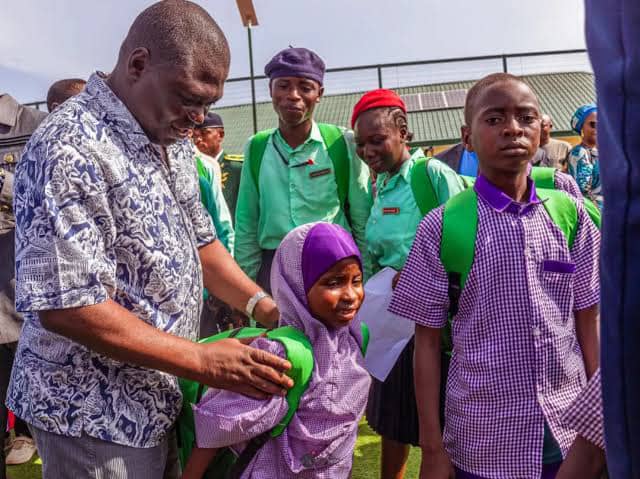
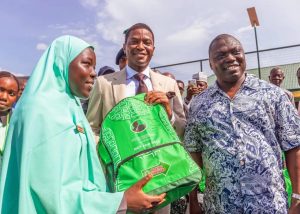
Beyond examination fees, the government has provided school uniforms, shoes, bags, didactic materials, and other educational necessities. Primary school pupils have also benefited from the distribution of learning materials and related support.
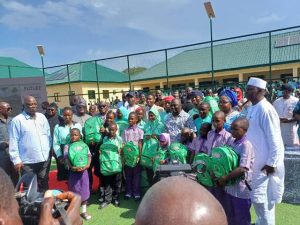
These measures reflect an understanding that making education free requires more than removing tuition charges. For families living on limited incomes, even the cost of basic school supplies can become an insurmountable obstacle.
By addressing some of these expenses, the government is seeking to widen access to education and reduce the number of children excluded from the classroom by poverty.
However, the ultimate measure of success will extend beyond the number of children enrolled or examination fees paid. Improved attendance, retention, learning outcomes, and completion rates will be essential indicators of whether the policy is delivering lasting benefits.
Teachers’ Salaries: Clearing the Backlog
An education policy cannot succeed without teachers. Their welfare, motivation, and regular payment of salaries are critical to the effective functioning of schools.
On this front, Commissioner Augustina disclosed that when Kefas assumed office, the government cleared a backlog of four months of unpaid teachers’ salaries. She added that salaries are now paid regularly.
The settlement of salary arrears represents an important step towards restoring confidence among teachers and strengthening the administration of public schools.
For teachers who have financial obligations to meet, delayed salaries can affect morale and undermine their ability to concentrate fully on their professional responsibilities.
Regular salary payments, therefore, are not merely an administrative achievement. They are part of the foundation upon which an effective education system must be built.
Nevertheless, sustaining this progress will require consistent budgetary provision, effective payroll management, and continued attention to other aspects of teachers’ welfare, including training, working conditions, and the availability of teaching resources.
The Ghost Workers Controversy
The government’s efforts to clean up the public service payroll have also generated controversy, particularly over individuals identified as ghost workers.
As part of its broader efforts to sanitise the system, the administration confronted persons suspected of drawing salaries without providing the corresponding services. Those affected, including individuals in sectors beyond education, disputed their classification and maintained that they were legitimate employees.
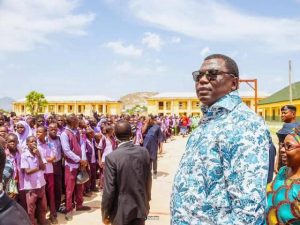
The disagreement resulted in protests on several occasions, exposing the difficulties that can accompany efforts to reform an established public service system.
Eventually, the government reportedly opted to offer fresh employment to the affected individuals, providing a way to resolve the dispute amicably.
The decision may have helped to ease tensions and prevent a prolonged confrontation. However, the broader lesson remains that public service reforms must be guided by transparent procedures, reliable records, and fair opportunities for affected workers to establish their employment status.
A credible payroll-cleaning exercise should eliminate fraudulent claims without penalising genuine employees. Equally, any settlement must protect public funds and ensure that recruitment and salary payments are based on verifiable employment arrangements.
For Taraba State, the challenge is to sustain the integrity of the payroll while maintaining industrial harmony and public confidence in government decisions.
Political Criticism and the Propaganda Debate
Despite the achievements drummed by the government, the free education policy has attracted criticism from opposition politicians, some of whom argue that the programme is not working as advertised.
According to these critics, the administration’s public presentation of its education initiatives amounts to propaganda rather than evidence of meaningful transformation.
The government, however, has rejected this position, describing the criticism as an attempt to discredit Governor Kefas’s programmes for cheap political gains.
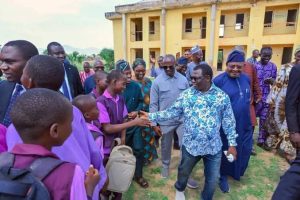
The disagreement reflects a familiar feature of democratic governance: the contest between a government seeking recognition for its policies and an opposition demanding proof of their effectiveness.
But education should be too important to become a casualty of partisan rivalry.
If the government believes that its policy is succeeding, it should demonstrate its impact through accessible information on enrolment, school attendance, examination registration, pass rates, school infrastructure, and the distribution of learning materials.
Similarly, opposition politicians have a responsibility to ground their criticism in evidence rather than dismissing the programme without examining its outcomes.
Ultimately, parents, pupils, teachers, and taxpayers deserve facts, not political slogans. An independent assessment of the programme would help establish what is working, identify implementation gaps, and provide a credible basis for improving the policy.
More Materials on the Way
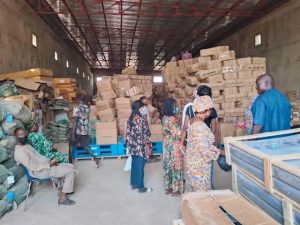
Dr Augustina Godwin has disclosed that additional truckloads of educational materials are available for distribution to the 16 local government areas of Taraba State in the coming days.
If the distribution is implemented effectively, it could extend the programme’s reach and provide further relief to pupils and parents who still struggle to meet the cost of schooling.
However, the effectiveness of such an exercise will depend on equitable distribution, proper record-keeping, and the timely delivery of materials to schools and pupils who need them most.
The government must also ensure that supplies are appropriate to the needs of different schools and that the materials reach their intended beneficiaries.
A transparent distribution system would not only strengthen public confidence but also make it easier to assess the programme’s reach and identify communities that remain underserved.
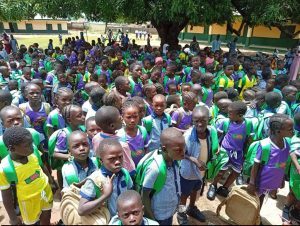
Moreover, distributing school materials is only one component of educational development. Classrooms, qualified teachers, functional laboratories, libraries, sanitation facilities, and a safe learning environment are equally important.
Free education must therefore be supported by sustained investment in the entire school system if increased access is to translate into improved learning.
The Unfinished Business of Scholarships and Employment
For all the strides attributed to the free education policy, Taraba State still faces significant challenges in extending educational opportunities beyond secondary school.
One major concern is the provision of scholarships and other forms of financial assistance for students seeking admission into tertiary institutions, both within Nigeria and abroad.
While free primary and secondary education can help children complete their basic schooling, many families may still struggle to finance university education, professional training, and specialised courses.
A well-structured scholarship scheme could help talented students from disadvantaged backgrounds pursue higher education, acquire specialised skills and contribute to the state’s development.
Such a programme would, however, require clear eligibility criteria, sustainable funding, and transparent selection procedures to ensure that assistance reaches deserving students.
The second challenge concerns employment opportunities for graduates.
Every year, institutions produce graduates who hope to secure jobs in the public service, private sector or other areas of the economy. Yet, when employment opportunities fail to keep pace with the number of qualified jobseekers, frustration and economic hardship can deepen.
The state’s ability to absorb some graduates into the civil service, where genuine vacancies and budgetary capacity exist, could provide relief. But public sector recruitment alone cannot offer a lasting solution.
Taraba needs a broader employment strategy that links education to the demands of the economy. Vocational training, entrepreneurship support, agricultural modernisation, technical skills development, and private sector investment should complement formal education.
Such an approach would help graduates become not only jobseekers but also potential employers and contributors to economic growth.
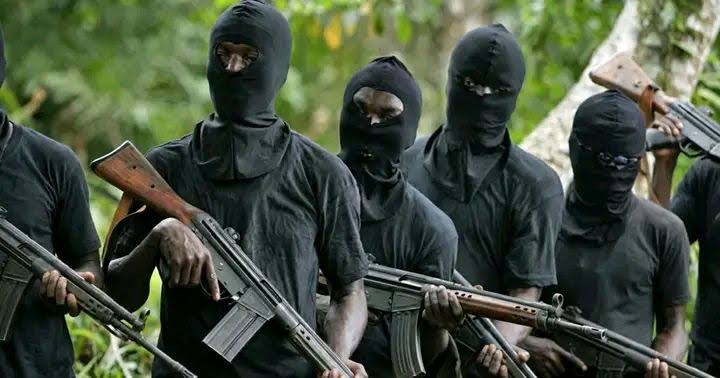
The relationship between unemployment, crime and insecurity also deserves careful consideration. Although unemployment does not automatically lead to criminal behaviour, prolonged economic exclusion can increase vulnerability to exploitation, recruitment into criminal networks, and other harmful activities. Expanding legitimate opportunities for young people would therefore be an important part of a wider strategy to promote social stability and security across the state.
Beyond Free Education
Governor Kefas’s free education policy has the potential to become one of the defining legacies of his administration. Its reported achievements in returning dropouts to school, supporting examination registration, providing educational materials, and clearing teachers’ salary arrears offer grounds for cautious optimism.
However, the long-term value of the programme will depend on its ability to move beyond access and affordability towards quality, sustainability, and opportunity.
The government must ensure that children who return to school receive an education that equips them with the knowledge and skills required to navigate an increasingly competitive world. Teachers must remain motivated, school facilities must improve, and public resources must be managed responsibly.
Equally important, the state must begin planning for the next stage of the educational journey: tertiary education, vocational development, and employment.
Free education should not end with a certificate that leaves its holder without a realistic path to further learning or productive work.
The ultimate test is whether Taraba can transform its educational investment into a generation of informed, skilled, and economically empowered citizens.
For Governor Kefas, the task is clear: consolidate the gains, address the shortcomings, and build a system that can withstand political transitions and economic pressures.
Free education is a commendable beginning. But its true success will be measured not simply by the number of children who enter school, but by the opportunities they gain, the skills they acquire, and the futures they are able to build.