








Labour Party candidate promises three industrial meg parks, 820-kilometre cargo rail network, agro-processing revolution and balanced development across Taraba’s three senatorial zones
By Iranyang Daniel Kukwen
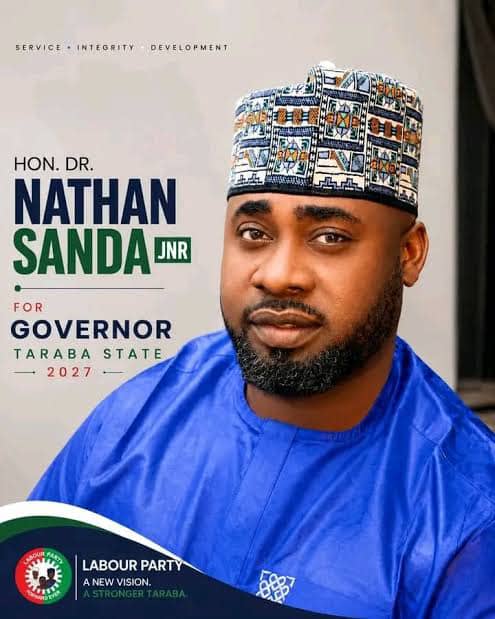
The Labour Party gubernatorial candidate in Taraba State, Hon. Dr. Nathan Sanda, has unveiled an ambitious industrialisation blueprint projected to attract up to 60 billion United States dollars in investment, generate nearly one million direct jobs and create wider employment opportunities estimated at 3.7 million as part of his vision for transforming the state into a major industrial and commercial hub.
Sanda presented the proposal during an appearance on SUM TV’s Today’s Politics, where he outlined a development agenda centred on the proposed Taraba Integrated Industrial Megapark, a 60,000-hectare industrial initiative designed to integrate agriculture, manufacturing, technology, mineral processing, energy, transportation and other productive sectors.
Describing Taraba as an underutilised economic powerhouse, the Labour Party candidate argued that the state possesses the land, agricultural resources, water, livestock, minerals and youthful population required to support a major industrial transformation.
He said his blueprint was designed to move Taraba beyond the production and sale of raw agricultural commodities towards an economy in which locally produced crops, minerals and other resources would be processed, manufactured and converted into higher-value products within the state.
The candidate said the proposal was backed by a detailed document containing step-by-step strategies for implementation, adding that the presentation on the programme was an executive summary of his wider industrialisation plan.
At the heart of the proposal are three strategically located industrial parks, one in each senatorial zone, with a proposed cargo rail network connecting production centres, processing facilities, markets and other industrial locations.
Three industrial parks to drive balanced development
Sanda said the proposed Taraba Integrated Industrial Megapark would occupy approximately 60,000 hectares, distributed across three industrial zones to promote equitable development rather than concentrating major investments in one part of the state.
According to his presentation, the northern industrial zone, proposed for Ardo-Kola, would occupy about 20,000 hectares, attract an estimated 22.5 billion dollars in investment and generate more than 380,000 jobs.
The proposed northern hub would accommodate industries associated with information and communications technology, electronics, agro-processing, engine production, power, telecommunications and cargo aviation.
The candidate said the other two industrial parks would be located in the central and southern zones, with their respective locations, industrial compositions and investment projections forming part of the wider development plan.
He explained that the three-zone arrangement was intended to ensure that the economic benefits of industrialisation reach communities across Taraba, creating opportunities for farmers, artisans, traders, professionals, investors and young people.
The proposed industrial development would also require supporting infrastructure, including electricity, water, transport connections, production facilities and logistics services, to make the state more attractive to local and international investors.
Agriculture: Turning Taraba’s farms into industrial wealth
Agriculture occupies a central position in Sanda’s proposed economic transformation strategy.
The candidate cited an estimated 4.8 million hectares of arable land as one of Taraba’s major economic advantages, arguing that the state’s agricultural potential should be used to establish industries capable of processing farm produce into finished and semi-finished goods.
He identified rice, cocoa, coffee, tea, cotton, cassava, yam, maize, sorghum, groundnuts, soybeans and sugarcane among the crops that could supply the proposed industrial network.
Under the proposed model, farmers would not only produce crops for immediate sale but could also supply factories involved in food processing, starch production, flour milling, edible oils, animal feed, textiles, beverages and other agricultural products.
Such an approach could create stronger commercial links between rural communities and industrial centres, providing markets for farmers while opening opportunities for transportation operators, agricultural input suppliers, equipment dealers and small businesses.
For rice-producing communities, for example, expanded processing facilities could support milling, packaging, storage and distribution. Cassava and yam producers could benefit from industrial processing into flour, starch and other products, while cocoa, coffee and tea could support higher-value processing and packaging activities.
Cotton production could similarly support textile-related industries, while maize, sorghum and soybeans could supply food manufacturers and animal-feed producers.
The blueprint therefore places agricultural value addition at the centre of its proposed job-creation strategy, with the prospect of linking rural production to larger commercial markets.
However, the scale of these opportunities would depend on the establishment of viable processing plants, reliable electricity, affordable financing, quality control, market access and arrangements that enable farmers to benefit from industrial expansion.
Livestock: Unlocking opportunities beyond cattle rearing
Sanda also identified livestock as a major component of Taraba’s potential industrial economy, citing an estimate of more than eight million livestock animals in his presentation.
He listed cattle, sheep, goats, pigs and poultry among the resources that could support a wider livestock value chain.
Under an industrial development model, livestock production could support meat processing, dairy products, leather processing, animal-feed manufacturing, veterinary services, cold-chain logistics and commercial distribution.
The development of properly equipped abattoirs and processing facilities could help reduce post-production losses, improve hygiene standards and create additional markets for livestock producers.
Leather processing could provide raw materials for footwear, bags and other manufactured products, while dairy facilities could support milk collection, processing and packaging where production conditions and commercial demand justify investment.
Poultry and other livestock operations could also stimulate demand for maize, soybeans and other animal-feed ingredients produced within Taraba.
For pastoralists, livestock farmers, veterinary professionals, traders and young entrepreneurs, the proposed approach offers a potential pathway from small-scale animal production towards a more organised commercial sector.
The candidate’s wider vision suggests that livestock should be treated not merely as a traditional rural occupation but as a resource capable of supporting processing industries and related businesses.
Mineral resources: Building industries around Taraba’s underground wealth
Another major component of the industrialisation proposal is mineral development.
Sanda identified iron ore, limestone, coal, bauxite, columbite, tin, lead, zinc, gold, lithium and sapphire among the mineral resources he believes are available in Taraba State.
He argued that mineral resources could support industries ranging from mineral processing and construction materials to metal-related manufacturing, provided that deposits are commercially viable and developed under appropriate regulatory and environmental standards.
Iron ore processing, for example, could potentially support metal production and related manufacturing activities. Limestone could supply cement and other construction-material industries where commercially viable deposits and adequate infrastructure exist.
Other mineral deposits could support specialised processing, industrial inputs and mineral-related services, depending on verified reserves, extraction costs, market demand and investment feasibility.
A properly regulated mining and processing sector could also generate employment for engineers, geologists, technicians, transport operators, equipment suppliers and skilled artisans.
For Taraba to benefit fully, however, mineral deposits would need systematic geological assessment, transparent licensing, appropriate environmental safeguards and investment in the infrastructure required to transport and process extracted materials.
Sanda’s proposal places mineral development within a broader strategy of converting the state’s natural resources into economic value within its borders rather than relying solely on the extraction and sale of raw materials.
Manufacturing and technology: Positioning Taraba for modern industry
The proposed industrial parks would also accommodate manufacturing and technology-based businesses.
In outlining the northern zone, Sanda identified information and communications technology, electronics, engine production, power, telecommunications and related industrial activities as priority areas.
These sectors could support technical training, equipment assembly, repairs, digital services, communications infrastructure and specialised industrial employment.
Electronics and technology-related enterprises could create opportunities for technicians, software professionals, engineers, installers and entrepreneurs, while telecommunications infrastructure could strengthen connectivity for businesses and communities.
Engine-related industries could support mechanical engineering, equipment maintenance and the servicing of machinery used in agriculture, transport and manufacturing.
The wider ambition is to create an environment in which Taraba’s economy is not limited to farming and the trading of raw commodities but also participates in manufacturing and technology-driven production.
For young people seeking employment, such industries could create pathways into technical careers, apprenticeships and specialised professional work.
Realising that ambition would require dependable electricity, skilled labour, industrial training, investor confidence, modern infrastructure and access to markets beyond the state.
Energy and power: Providing the foundation for industrial growth
Reliable power is indispensable to the proposed industrial transformation.
Sanda included power among the sectors expected to feature in the northern industrial park, recognising the importance of energy to manufacturing, food processing, refrigeration, technology and other commercial activities.
Industrial expansion would require an energy system capable of supporting factories, warehouses, workshops and businesses without excessive interruptions or prohibitive operating costs.
Depending on feasibility studies and investment arrangements, the development strategy could explore a mix of grid electricity, embedded generation and renewable energy solutions to meet the needs of industrial users.
Reliable electricity could help agricultural processors preserve perishable produce, enable manufacturers to operate machinery and improve the competitiveness of businesses producing goods for local and external markets.
Energy investments could also create employment for electrical engineers, technicians, installers and maintenance workers.
The details of the proposed power programme, including its generation capacity, financing structure and delivery schedule, would need to be established through further technical planning.
Cargo rail and logistics: Connecting producers to markets
One of the most striking elements of Sanda’s proposal is an estimated 820-kilometre cargo rail network intended to connect the industrial zones and improve the movement of goods across Taraba.
He said the proposed network would link major industrial locations in a triangular arrangement, with routes described in his presentation as connecting areas including Ardo-Kola, Bali and Wukari towards a central meeting point.
The objective, he explained, would be to transport agricultural products, raw materials and manufactured goods efficiently from production locations to processing plants and commercial destinations.
If feasible and implemented, such a network could reduce dependence on road transportation for suitable freight, improve supply-chain efficiency and strengthen links between farms, factories and markets.
Rail infrastructure could also create employment in construction, engineering, operations, maintenance, cargo handling and logistics management.
The proposal would nevertheless require detailed route surveys, feasibility assessments, land acquisition, environmental studies, financing agreements and coordination with existing national transport infrastructure.
Sanda’s vision is that transport should function as an economic connector, ensuring that investments in agriculture and manufacturing are supported by an effective system for moving goods.
Forestry, bamboo and other natural resources
The candidate also highlighted Taraba’s forests, tropical hardwood, bamboo resources and medicinal plants as potential contributors to economic development.
With appropriate environmental controls, sustainable forestry and bamboo processing could support furniture production, construction materials, selected manufacturing activities and other forest-based enterprises.
Medicinal plants could offer opportunities for research, regulated processing and the development of commercial products where scientific evidence, safety standards and market conditions support such activities.
These opportunities would require responsible resource management to prevent deforestation, protect biodiversity and ensure that commercial activities do not undermine the ecological systems on which local communities depend.
The proposal’s emphasis on sustainability would therefore need to be reflected in enforceable environmental standards, responsible land-use planning and measures to protect forest-dependent communities.
Fisheries and water resources: Supporting food production and enterprise
Sanda further pointed to Taraba’s rivers, streams and groundwater resources as assets that could support agriculture, fisheries and industrial activity.
He specifically referenced the River Benue, River Taraba, River Donga and other watercourses as important features of the state’s natural resource base.
The proposed development framework could create opportunities in commercial fish farming, fish processing, cold storage, packaging, transportation and distribution, while irrigation infrastructure could help farmers manage seasonal variations in rainfall.
Fish-processing facilities could provide additional markets for fishing communities and reduce losses associated with inadequate preservation and transportation.
Water resources would also be important for food-processing factories and other industrial facilities, although sustainable extraction, treatment, wastewater management and protection of river ecosystems would be essential.
The candidate’s broader argument is that Taraba’s water resources should be treated as productive economic assets, managed responsibly to support food security, livelihoods and industrial development.
Youth employment and skills development
Sanda’s presentation identified the state’s youthful population as a major advantage, estimating that about 62 per cent of Taraba’s population is below the age of 30.
He argued that industrialisation could create opportunities for young people through direct employment, vocational training, entrepreneurship and participation in emerging manufacturing and technology sectors.
The projected 965,000 direct jobs and 3.7 million total employment opportunities at full capacity are among the most ambitious figures in the blueprint.
The wider employment estimate appears to include both direct and indirect opportunities, potentially extending across agriculture, construction, transport, trade, services and industrial supply chains.
For young people in rural and urban communities, the anticipated benefits could include jobs as technicians, machine operators, engineers, factory workers, drivers, logistics personnel, digital professionals and business owners.
However, the projections remain estimates presented by the candidate and would require independent assessment of the proposed industries, investment requirements, labour demand and implementation timetable.
A credible employment programme would also need to connect industrial investment with vocational education, apprenticeships, local recruitment and skills-development initiatives so that Taraba residents are prepared to take advantage of emerging opportunities.
A $60 billion investment ambition
Sanda projected that the industrialisation programme could attract up to 60 billion dollars when fully developed.
He acknowledged that the scale of the ambition might appear unrealistic to some people but maintained that the objective could be pursued through collective effort, strategic partnerships and phased implementation.
His proposal envisages cooperation between government, private investors and other partners, with industrial infrastructure serving as a platform for commercial investment.
The scale of the projected investment would make the availability of credible feasibility studies, financing commitments, transparent public-private partnerships and clear governance arrangements especially important.
The proposed programme would also need to demonstrate how public resources would be protected, how private investors would earn sustainable returns and how host communities would benefit from land use and industrial activity.
Sanda said the detailed blueprint contains step-by-step strategies and presented the industrialisation initiative as a long-term framework capable of continuing beyond the tenure of an individual governor.
Four years to lay the foundation
Although the proposed development programme carries an eight-year projection from 2027 to 2035, Sanda maintained that his immediate ambition would be to establish its foundations within a single four-year gubernatorial term.
He said he was not presenting the eight-year timeline as a justification for seeking a second term, arguing instead that a well-defined development blueprint should be capable of surviving a change of administration.
According to him, the priority would be to initiate the programme, establish its institutional and investment foundations and create a framework that a future administration could continue.
He also directed interested members of the public to www.sanda2027.org and www.sanda2027.com, where he said the detailed industrialisation presentation could be obtained.
Can the blueprint redefine Taraba’s economic future?
Taraba’s agricultural potential, natural resources and strategic location offer opportunities for economic expansion. Sanda’s proposal attempts to bring these assets together under a single industrial development strategy built around large-scale investment, processing, manufacturing, infrastructure and employment.
Its appeal lies in the promise of moving beyond the sale of raw commodities towards an economy that creates additional value from what the state already produces.
For farmers, the vision is stronger markets and more opportunities for processing. For young people, it is the prospect of technical employment and new businesses. For traders and manufacturers, it is the possibility of improved infrastructure, wider markets and increased commercial activity.
For the state as a whole, the proposal presents an ambitious picture of geographically balanced industrial growth across the three senatorial zones.
Yet the decisive test will be whether the projections can be translated into feasible projects supported by financing, verified resource assessments, infrastructure, environmental protection, investor commitments and measurable implementation targets.
As Taraba approaches the 2027 governorship election, Sanda’s industrialisation blueprint places economic diversification and large-scale job creation at the centre of his campaign message, offering voters a substantial proposal to examine alongside the plans and records of other contenders.
The central question for voters is not only how ambitious the vision appears, but also how clearly its financing, implementation, accountability and expected benefits can be demonstrated.