
APGA candidate promises water for communities, mechanised agriculture, improved roads, healthcare, education and inclusive governance
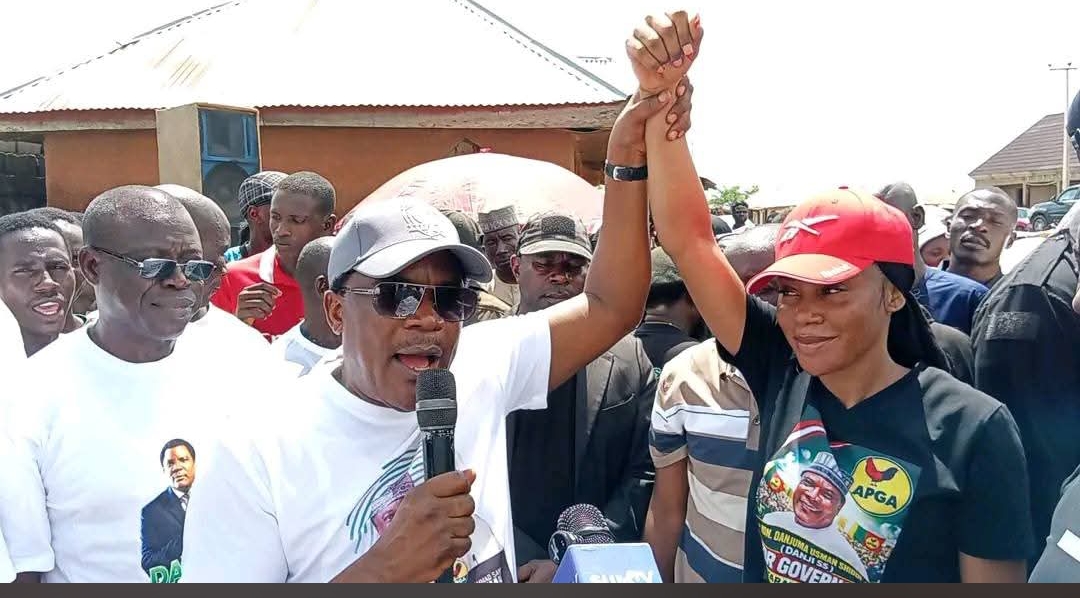
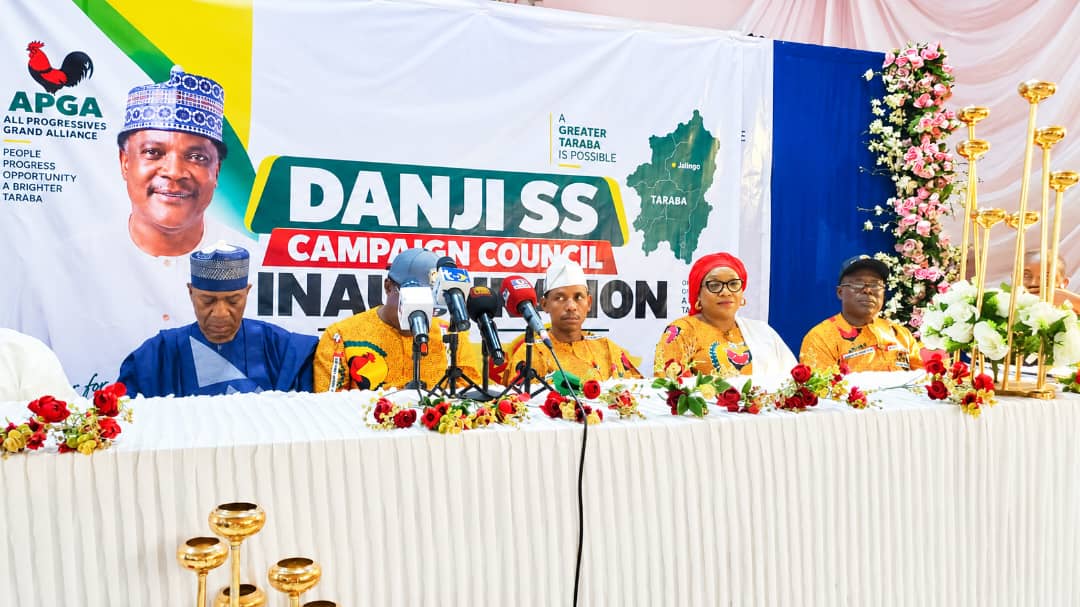
The governorship candidate of the All Progressives Grand Alliance (APGA) in Taraba State, Hon. Danjuma Usman Shiddi, popularly known as Danji SS, has unveiled his “Rescue Taraba” manifesto and inaugurated his campaign council ahead of the 2027 governorship election.
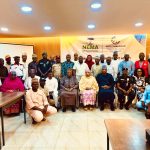
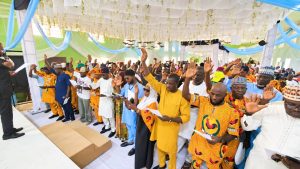
The event, held at the Pastoral Centre of the Catholic Church in the Mile Six area of Jalingo, brought together APGA leaders, members of the campaign organisation, supporters, political stakeholders and representatives of different groups.
The manifesto, titled “Rescue Taraba: A People-Centred Manifesto for Taraba State,” outlines a 10-point agenda centred on water supply, education, security, agriculture, healthcare, roads and bridges, youth and women empowerment, job creation and investment, transparency and accountability, as well as unity and inclusive governance.
The inauguration also formally activated the campaign structure expected to coordinate APGA’s mobilisation and campaign activities across the state’s 16 local government areas. Prof. Ambrose Zemba had earlier been named Director-General of the campaign organisation, with subsequent appointments expanding the structure across communication, mobilisation, youth, women and zonal coordination.
DANJI: ‘WE ARE ON A RESCUE MISSION’
Addressing the gathering, Shiddi described his 2027 governorship bid as a “rescue mission,” saying the objective was to address what he considers shortcomings in governance and service delivery in the state.
He said the campaign was not about rescuing Taraba from an individual or political party, but about rescuing what he described as the state’s collective potential from challenges including poor infrastructure, insecurity, unemployment, inadequate public services and weak accountability.
> “Today is not merely the inauguration of a campaign council. It is the formal commencement of a collective journey — a journey born out of our shared desire for a better Taraba,”
Shiddi said he had travelled through communities and listened to concerns from farmers, young people, women, civil servants, businesses and other residents.
According to him, Taraba possesses fertile land, natural resources, a rich cultural heritage and a youthful population capable of contributing significantly to the state’s development.
He said the central question should therefore be how the state can convert its potential into measurable development.
FIVE PRINCIPLES FOR GOVERNMENT
The APGA candidate said an administration under his leadership would be guided by integrity, accountability, competence, inclusion and action.
He said his government would not promise everything, but would identify priority problems, mobilise resources, establish measurable targets and assess results.
He also promised an all-inclusive government, saying citizens would be carried along irrespective of ethnic, religious, geographical or political differences.
WATER FOR EVERY COMMUNITY
Water supply featured prominently in the manifesto.
Shiddi promised to establish what he called a comprehensive Taraba Water Programme, involving the development and rehabilitation of water schemes in major towns and expansion of reliable water sources to communities across the state.
He proposed the use of solar-powered community water systems where appropriate and sustainable maintenance arrangements involving government, communities, development partners and the private sector.
He said water infrastructure in schools and healthcare facilities would also receive attention.
According to him, the objective would be to ensure that residents do not have to depend on unsafe water because of inadequate government provision.
FROM SUBSISTENCE TO MECHANISED AGRICULTURE
Agriculture is another major component of the manifesto.
Shiddi said Taraba must move beyond subsistence farming towards a modern agricultural economy that connects farmers to inputs, extension services, machinery, storage, processing, markets and investment.
He promised to support irrigation and dry-season farming where feasible, strengthen farmer cooperatives, improve market access and encourage private-sector investment in agricultural value chains.
He also proposed livestock development and agricultural enterprise opportunities for young people.
The candidate said his objective was to move Taraba farmers from subsistence production into productive agricultural enterprises.
ROADS, BRIDGES AND RURAL CONNECTIVITY
On infrastructure, Shiddi expressed concern over the condition of roads and bridges in several parts of the state.
He particularly cited the situation in Karim Lamido, where he said residents in some communities face severe difficulties crossing rivers and accessing other parts of the local government.
He also raised concerns over the condition of the Namnai Bridge, which he alleged had remained unrepaired for about three years.
The candidate further said poor road conditions had affected movement to Wukari, claiming that travellers could spend more than five hours on the journey.
He said his proposed administration would prioritise roads and bridges based on public need and economic value, particularly infrastructure linking farming communities to markets, schools, healthcare facilities and other economic centres.
His campaign has previously framed his position on major infrastructure projects, including the proposed Wukari Flyover, as an issue of development priorities rather than opposition to infrastructure development.
EDUCATION: ‘OUR CHILDREN DESERVE SCHOOLS WHERE LEARNING CAN TAKE PLACE’
The APGA candidate also made education a central part of his proposed development programme.
He criticised what he described as inadequate infrastructure in schools and questioned the effectiveness of the current administration’s free education policy.
According to Shiddi, some schools still lack basic facilities required for effective teaching and learning.
He promised to rehabilitate dilapidated classrooms, provide furniture and essential learning materials, strengthen teacher training and professional development, improve monitoring of teaching and learning, and expand technical and vocational education.
He also proposed greater use of digital literacy and technology-based learning.
“Education is not expenditure. Education is the foundation upon which every other sector depends,” he said.
HEALTHCARE: ‘TARABANS SHOULD NOT TRAVEL OUT FOR BASIC SERVICES’
Healthcare was another major area addressed by Shiddi.
He expressed concern over the state of some healthcare facilities and said residents sometimes travel to neighbouring states, including Gombe and Adamawa, to access medical services which he believes should be available within Taraba.
He specifically highlighted the need for improved diagnostic services, including access to CT-scan facilities, while calling for rehabilitation and equipping of hospitals.
Under his proposed healthcare plan, he said primary healthcare facilities would be strengthened, essential medicines and equipment improved, maternal and child healthcare prioritised, and selected secondary healthcare facilities upgraded.
He also proposed strategic investment in specialist medical services and emergency response.
YOUTH AND WOMEN
Shiddi said young people and women would have a significant role in his proposed administration.
His manifesto proposes expanded skills acquisition, entrepreneurship, vocational training, technology and digital enterprise, youth-focused agricultural programmes and access to legitimate financing opportunities.
He also pledged greater participation of women and young people in government and development programmes based on competence, merit and representation.
JOB CREATION AND INVESTMENT
The APGA candidate acknowledged that government cannot employ every resident and said his administration would therefore focus on creating an environment where businesses can invest, expand and generate employment.
His manifesto proposes support for local enterprises, agro-processing and value addition, investment promotion mechanisms, public-private partnerships and the identification of sectors where Taraba has economic advantages.
SECURITY AND COMMUNITY SAFETY
On security, Shiddi said meaningful development cannot take place when citizens are afraid to travel, farm or conduct legitimate businesses.
His proposed security framework includes greater cooperation between conventional security agencies, government, traditional institutions and communities, within the law.
He also proposed community-based intelligence and early-warning mechanisms, alongside measures to protect farming communities and major economic corridors.
His campaign message on security is: “Secure the people. Secure the farms. Secure the future.”
ACCOUNTABILITY AND PUBLIC EXPENDITURE
Shiddi also promised greater transparency in the management of public resources.
He said government money must be treated as public money and proposed stronger financial accountability, transparent procurement, measurable performance indicators and monitoring of major government projects.
He said citizens should be able to ask legitimate questions about government without being treated as enemies.
> “Constructive criticism is not an attack on government. It is one of the instruments through which government improves,” he said.
UNITY AND INCLUSIVE GOVERNANCE
The APGA candidate pledged to promote unity among Taraba’s diverse ethnic and religious communities.
He listed communities including the Jukun, Tiv, Kuteb, Mambilla, Fulani, Chamba, Wurkun, Mumuye, Ichen and Hausa among the groups that make up the state, stressing that every citizen should have equal dignity, security and opportunity.
He promised to build bridges across ethnic, religious, geographical and political divides.
“There will be no first-class Tarabans and second-class Tarabans,” he said.
‘EXAMINE OUR IDEAS AND HOLD US ACCOUNTABLE’
Shiddi urged voters not to judge his campaign solely on slogans, but to examine its proposals and hold him accountable to them.
He asked residents to scrutinise his programme, character and record, and to ask difficult questions before deciding whether to support his political platform.
His words to the electorate were: “We must earn trust, not demand it.”
CHARGES CAMPAIGN COUNCIL TO AVOID FALSE INFORMATION
While inaugurating the campaign council, Shiddi charged members to take the party’s message to communities across the 16 LGAs.
He instructed them not to insult opponents, spread false information or provoke violence, and warned against making promises that cannot be delivered.
He urged campaign officials to listen to residents, document their concerns, explain the party’s programmes and conduct themselves in a manner consistent with the type of government they seek to establish.
He called for a peaceful, disciplined, issue-based and people-centred campaign.
CAMPAIGN COUNCIL
Prof. Ambrose A. Zemba is the Director-General of the campaign council, while Samaila Yakubu, popularly known as Young JP, serves as Deputy Director-General for the Southern Zone.
Other members include Umaru Emmanuel, Director of Communications and Strategy; Almajiri Leonard Wilson, Director of Youth Mobilisation and Strategy; Hanifatu Sani, Director of Women Mobilisation and Support Groups; Abubakar Umar Sunkan, Director of Mobilisation and Support Groups; and Onuorah Peter, popularly known as Chesco Federal, Director of Resident Communities Mobilisation and Support Groups.
Barrister Yakubu Andesiunde is Director of Legal Services, while Hon. Salamatu Abubakar serves as Director of Grassroots Women Mobilisation, Religious and Community Leaders.
Kabiru Muhammad Shuaibu is Deputy Director-General for the Central Zone.
The campaign structure had been expanded in stages following the earlier appointment of Prof. Zemba as Director-General.
100-DAY PLAN AND MEASURING RESULTS
In the manifesto, Shiddi also proposed an initial assessment of critical sectors within the first 100 days of an administration, including water infrastructure, schools, primary healthcare, roads and bridges, security, agricultural support systems, government finances and the status of ongoing public projects.
He said the purpose would be to establish an evidence-based baseline from which government could set priorities.
The manifesto states that major programmes would be assessed on the basis of need, cost, expected public benefit, implementation capacity, sustainability and measurable outcomes.
The APGA candidate said his administration would not claim that every problem could be solved overnight, but would instead focus on identifying priorities and delivering measurable results.
The unveiling of the manifesto and inauguration of the campaign council mark a significant step in APGA’s preparations for the 2027 governorship election, as political parties and candidates continue to expand their structures and engage communities across Taraba’s 16 local government areas. INEC’s published list of Taraba governorship candidates includes Shiddi as the APGA candidate.