
By Iranyang Daniel
As 2027 approaches, the ADC candidate questions Kefas’ record, APC’s unity and the political credentials of the men seeking to occupy the Government House.
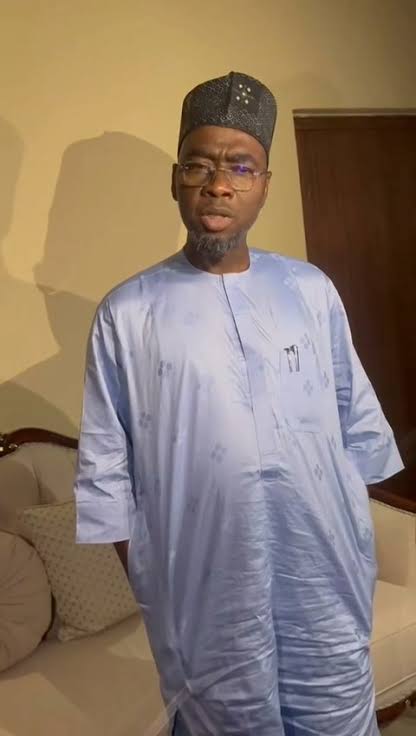
The race for Taraba State’s Government House is gradually becoming a contest of political arithmetic, historical comparisons and increasingly colourful declarations. In a recent appearance on Trust TV’s Daily Politics, former senator and African Democratic Congress (ADC) governorship candidate, Abubakar Umar Tutare, delivered a blistering assessment of Governor Agbu Kefas, declaring that the incumbent has no realistic path to re-election in 2027.

Tutare did not merely question the governor’s chances; he appeared ready to conduct the political funeral before the electorate had even arrived at the polling booth. According to him, Kefas cannot win even one local government area. It was a bold prediction, although Taraba’s voters, rather than television studios, will eventually determine whether that confidence is political foresight or another case of campaign-season optimism.
The ADC candidate also questioned the administration’s performance, alleging that it had not executed any project worth ₦5 billion. He further claimed that the state had accumulated loans approaching ₦1 trillion. These assertions remain Tutare’s political claims and should not be confused with independently established financial figures.
But if Tutare was sharpening his political machete against Kefas, the other contenders were not entirely outside its reach. In a contest where nearly everybody appears convinced that the people are waiting exclusively for his arrival, Taraba voters may yet discover that the candidates have more confidence in their own popularity than the electorate has demonstrated.
APC’S UNITY: A HOUSE UNITED BY DEFECTION, DIVIDED BY LEADERSHIP?
Tutare also questioned the political cohesion of the ruling All Progressives Congress (APC), arguing that Kefas has not been fully accommodated following his defection from the Peoples Democratic Party.
He cited disagreements surrounding the state congress and the party’s leadership structure as evidence of unresolved tensions. The dispute has indeed attracted legal attention. A Federal High Court in Jalingo dismissed a suit challenging the March 3, 2026, APC state congress on grounds relating to the failure to exhaust internal party dispute-resolution mechanisms. An appeal was subsequently filed at the Court of Appeal, Yola Judicial Division.
The political irony is difficult to miss: a party that welcomes a sitting governor with the expectation of electoral advantage must still demonstrate that its new political family can agree on who holds the family key.
Yet Tutare and his camp should not celebrate too early. A party’s internal disagreement does not automatically translate into votes for its opponents. Political disunity may create an opening, but only a credible alternative can turn that opening into an electoral advantage.
THE DEBT QUESTION: BETWEEN POLITICAL BILLIONS AND PUBLIC RECORDS
Tutare’s allegation of nearly ₦1 trillion in loans has placed Taraba’s debt profile back in the political conversation. However, available debt figures must be distinguished from campaign claims.
Data from the Debt Management Office put Taraba’s domestic debt at approximately ₦80.92 billion as of March 31, 2026, compared with about ₦85.51 billion at the end of December 2025. These figures represent domestic debt and do not, on their own, account for every possible liability or borrowing category.
As expected during electioneering, the Kefas administration should take the opportunity to explain its borrowing, expenditure and project delivery record. Equally, Tutare and other opposition figures should provide the documentary basis for the much larger figure being circulated.
In an election season, billions can become political adjectives. But public finance is not a poetry competition: figures require records, explanations and accountability.
SUNTAI, NYAME AND THE POLITICS OF NOSTALGIA
In comparing administrations, Tutare described former Governor Danbaba Suntai as the best governor Taraba has had, arguing that several projects later showcased by subsequent administrations were inherited from his tenure. He also acknowledged that former Governor Jolly Nyame did his best.
Such historical comparisons may stir nostalgia among voters, but nostalgia is not a development plan. Every administration must be judged by what it inherited, what it completed, what it abandoned and what it delivered.
Suntai’s supporters may insist that his legacy remains unmatched. Nyame’s loyalists may offer their own defence. Kefas’ camp will naturally point to its ongoing programmes and projects. But citizens are entitled to ask a simple question: what has improved in their communities, and what can they actually see?
Tutare also described Jalingo as underdeveloped and unusually quiet by 8pm. That assessment may resonate with residents concerned about urban growth and economic activity, but it also raises a question for the opposition: beyond describing the state capital’s shortcomings, what practical plan, particularly in the area of security, does the ADC candidate have to transform it?
FIVE CONTENDERS, MANY AMBITIONS, ONE GOVERNMENT HOUSE
Tutare identified himself, Senator Emmanuel Bwacha and Governor Kefas among the leading contenders for the 2027 governorship race. He also mentioned Danjuma Usman Shiddi and other political figures as significant players.
The field presents a familiar Taraba political spectacle: the incumbent believes his record should speak for him; the former senator believes experience gives him an advantage; Bwacha has his own political constituency; and the other contenders are equally entitled to believe that the Government House is within reach.
But political ambition is not the same as electoral strength. A candidate may command applause at a rally and still struggle to command votes across polling units. Another may enjoy impressive political connections but discover that voters are not necessarily transferred like property from one political camp to another.
The official INEC candidate list previously referenced in the political discussion contained 19 candidates, including Kefas for the APC, Bwacha for the PDP, Tutare for the ADC, Danjuma Usman Shiddi for APGA, Jerome Nyameh for Accord and Mohammed Yahaya for the NDC.
With such a crowded field, the contest may be less about who makes the loudest declaration and more about who can build a convincing statewide coalition.
THE WUKARI FACTOR: SHIDDI, KEFAS AND THE POLITICS OF HOME ADVANTAGE
Tutare also made claims about the relative popularity of Danjuma Usman Shiddi and Governor Kefas in Wukari Local Government Area, their shared local government. He suggested that Shiddi may enjoy stronger grassroots acceptance there.
He further speculated that Kefas’ relationship with the Danjuma family could have political implications for Shiddi’s ambition, although he expressly stated that he was not alleging that any request had been made for Shiddi to step down.
That distinction matters. Familiarity, political alliances and personal relationships may generate speculation, but they do not establish political agreements. Shiddi’s ambition should be judged by his political organisation and electoral appeal, not by assumptions about personal relationships.
And there is a wider lesson for every contender: sharing a local government with the governor does not automatically make anyone the preferred son of the electorate. Wukari voters are not political inheritance waiting to be transferred from one household to another.
A SENATOR RETURNS, AND THE RECORD ALSO RETURNS WITH HIM
Tutare is not a newcomer to Taraba politics. He served as commissioner under Jolly Nyame, Secretary to the State Government under Danbaba Suntai and senator representing Taraba Central between 2011 and 2015.
His experience gives him a basis to speak about governance, but it also makes his own record fair game for public scrutiny. If he is asking voters to assess Kefas, voters may reasonably ask what he achieved in the offices he previously occupied and what distinguishes his proposed administration from those he once served.
The same standard applies to Bwacha, Shiddi and every other aspirant. Nobody should be allowed to campaign exclusively with the failures of opponents while keeping his own political history safely locked away.
THE REAL VERDICT WILL NOT COME FROM THE TELEVISION STUDIO
The 2026 Taraba budget stands at approximately ₦650.63 billion, with ₦457.74 billion allocated to capital expenditure and ₦192.89 billion to recurrent expenditure. Those figures provide another basis for assessing the administration, but budgetary allocations are not the same as completed projects or improved living conditions.
For Kefas, the challenge is to defend his record with visible results rather than relying on the prestige of incumbency or the symbolism of political defections.
For Tutare, the task is to demonstrate that his criticism is matched by a credible alternative and a record that can withstand scrutiny.
For Bwacha, Shiddi and the other aspirants, the challenge is to prove that their political structures extend beyond familiar names, loyal supporters and the optimism of campaign gatherings.
Taraba does not need a competition in which every candidate declares himself the people’s undisputed choice. It needs a contest in which every contender is prepared to answer questions about roads, schools, hospitals, jobs, security, public debt and the everyday cost of survival.
Tutare may have fired the loudest salvo in the Trust TV interview, but he has also reminded the political class of an uncomfortable truth: in Taraba, nobody should campaign as the examiner without being prepared to sit for the examination.
The governor may have the advantage of the seat, the opposition may have the advantage of criticism, and the other aspirants may have the advantage of ambition. But none of these is a substitute for public trust.
In 2027, the ballot box will have the final word. And unlike a television interview, it will not give any candidate unlimited time to explain why everybody else deserves the blame.