




WHY THE NPA MUST BE JUDGED BY ITS RECORD OF PERFORMANCE — ENEMIES OF NIGERIA’S ECONOMIC STABILITY MUST DESIST!
A REJOINDER TO THE CALL FOR THE REMOVAL OF THE MANAGING DIRECTOR OF THE NIGERIAN PORTS AUTHORITY, DR. ABUBAKAR DANTSOHO
By Amb. Salahuddeen Shuaibu Planner
The recent call by a Coalition of Maritime and Energy Consultants for President Bola Ahmed Tinubu to remove the Managing Director of the Nigerian Ports Authority (NPA), Dr. Abubakar Dantsoho, over allegations of poor governance, administrative shortcomings and mounting controversies, deserves a sober, objective and evidence-based response.

While accountability, transparency and institutional discipline remain essential ingredients of good governance, it is equally important that public discourse should not become a platform for selective criticism, unsubstantiated accusations or campaigns that risk undermining confidence in important national institutions.
Nigeria is at a critical stage of economic transformation. Its maritime sector is central to international trade, foreign exchange earnings, industrial development, employment generation and national revenue. Consequently, discussions about the leadership of the Nigerian Ports Authority must be guided by verifiable performance indicators, institutional realities and a genuine commitment to national economic progress.
The question Nigerians should ask is simple: Should the leadership of a strategic national institution be evaluated solely through allegations and controversies, or should its measurable achievements, ongoing reforms and contributions to the national economy also receive fair consideration?
Dr. Abubakar Dantsoho assumed office in July 2024 following his appointment by President Bola Ahmed Tinubu. Since then, the Authority has pursued several initiatives involving revenue optimisation, port modernisation, digital transformation, international maritime cooperation and staff welfare.
These developments deserve proper examination before any conclusion is reached about his stewardship.
REVENUE GENERATION: A SIGNIFICANT CONTRIBUTION TO THE NATIONAL ECONOMY
One of the most important responsibilities of the Nigerian Ports Authority is revenue generation and remittance to the Federal Government.
Available financial records provide substantial evidence of the Authority’s revenue performance during the period under review.
In 2024, the NPA generated ₦894.86 billion, surpassing its revenue target of ₦865.39 billion. This was accompanied by a contribution of approximately ₦400.8 billion to the Consolidated Revenue Fund, almost double the ₦213.23 billion remitted in 2023.
These figures were disclosed by Dr. Dantsoho during the Authority’s 2025 budget defence before the National Assembly.
The Authority subsequently established a revenue target of approximately ₦1.28 trillion for 2025, reflecting its ambition to improve financial performance through increased cargo traffic, improved operational efficiency, technology adoption and infrastructure development.
It is important to distinguish a projected target from actual revenue realised. Nevertheless, the 2024 figures demonstrate that the Authority exceeded its approved revenue target and substantially increased its remittance to the national treasury.
At a time when the Federal Government requires additional resources to finance infrastructure, education, healthcare, security and other national priorities, the contribution of revenue-generating agencies such as the NPA deserves serious consideration.
Revenue generation is not merely an institutional achievement; it is a contribution to national development.
PORT MODERNISATION AND INFRASTRUCTURAL DEVELOPMENT
Another significant aspect of the Dantsoho administration is its focus on addressing infrastructure deficits and improving the competitiveness of Nigerian ports.
The Authority has advanced rehabilitation initiatives covering major port facilities, including:
– Tin Can Island Port Complex.
– Apapa Port Complex.
– Rivers Port.
– Onne Port.
– Warri Port.
– Calabar Port.
The proposed $1 billion reconstruction of the ageing Tin Can Island Port Complex is particularly significant, given the importance of the facility to Nigeria’s maritime economy.
The NPA has also advanced discussions and investment frameworks relating to new port development, including the $1 billion Snake Island Port project, alongside ongoing initiatives involving Badagry, Ondo and other proposed deep seaports.
These initiatives are designed to expand port capacity, attract private investment, improve cargo handling and strengthen Nigeria’s position as a regional maritime and logistics destination.
Port development is not an overnight undertaking. It requires capital mobilisation, technical assessments, regulatory approvals, stakeholder consultations and sustained institutional coordination.
Therefore, ongoing projects should be assessed according to their actual implementation stages rather than dismissed simply because every infrastructure challenge has not yet been resolved.
INTERNATIONAL PARTNERSHIPS AND NIGERIA’S MARITIME DIPLOMACY
Under Dr. Dantsoho’s leadership, the NPA has also pursued stronger international maritime relationships.
His emergence as President of the Port Management Association of West and Central Africa (PMAWCA) represents an important development in Nigeria’s regional maritime engagement. He also assumed leadership responsibilities within the Pan-African Association for Port Cooperation.
The Authority has pursued international institutional cooperation, including Nigeria’s membership of the International Port Community Systems Association (IPCSA), an important step towards strengthening the country’s digital trade infrastructure.
These engagements provide opportunities for knowledge exchange, technical cooperation, investment promotion and the adoption of international best practices.
Nigeria cannot become a leading maritime hub while operating in isolation from global developments. International partnerships are therefore essential to the modernisation of our ports and the expansion of our maritime economy.
STAFF WELFARE: THE HUMAN DIMENSION OF INSTITUTIONAL MANAGEMENT
An institution is only as productive as the people who operate it.
When Dr. Dantsoho assumed office, he emphasised the importance of staff welfare, productivity, training and institutional cooperation.
According to the NPA’s published account of its performance improvements, his administration, working with the relevant unions and management, addressed longstanding employee promotion stagnation through promotion examinations.
Other reported welfare measures included:
– Increased productivity bonuses.
– End-of-year welfare packages for employees.
– Review of the Financial Guide to the Conditions of Service.
– Greater engagement with maritime labour unions.
– Attention to employee compensation and capacity development.
These interventions are important because industrial harmony, employee motivation and professional development directly affect institutional productivity.
The management of a national institution should not be assessed exclusively by its financial statements and infrastructure projects. The welfare of the workforce responsible for delivering those results must also be considered.
HUMANITY BEYOND THE OFFICE: DANTSOHO’S CONTRIBUTION TO TARABA STATE
Beyond his responsibilities at the Nigerian Ports Authority, Dr. Abubakar Dantsoho has attracted public attention through humanitarian interventions in his home state of Taraba.
Public service should not end at the boundaries of an office. Leadership is also reflected in the willingness to use one’s influence, personal resources and institutional opportunities to address the needs of vulnerable communities.
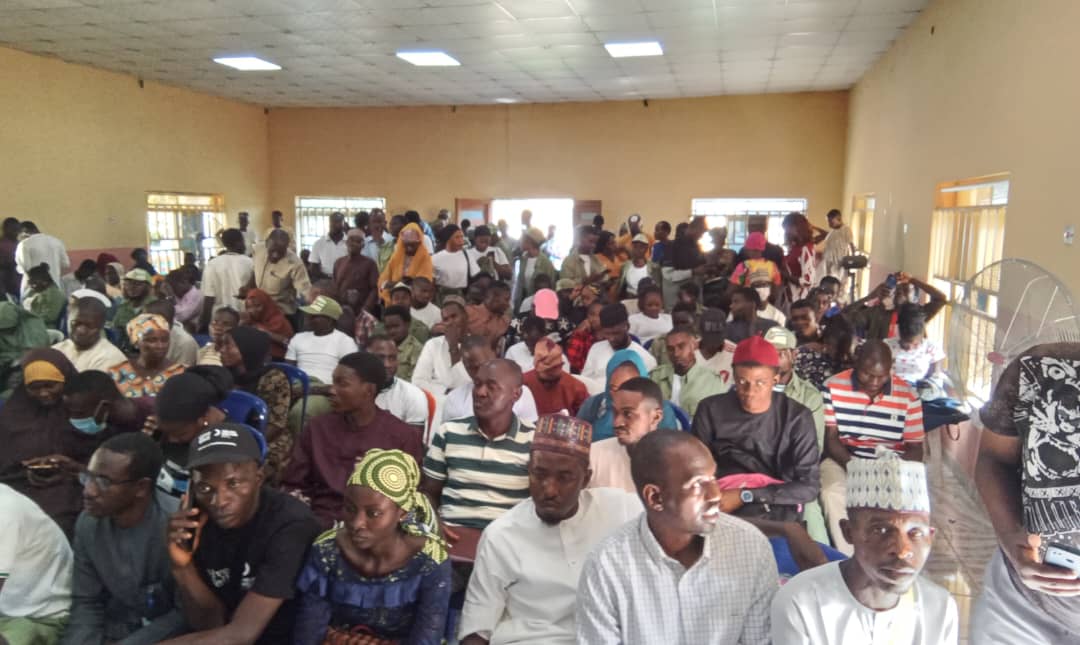
One notable intervention was the free medical outreach launched in September 2025 in Sintali Ward, Jalingo.
The initiative provided free medical consultations, diagnostic services, medications, antenatal services, health counselling and mosquito nets to beneficiaries, particularly women, children and vulnerable residents.
In another intervention reported in 2026, the Nigerian Ports Authority donated a 500kVA generator valued at approximately ₦115 million to the Federal Medical Centre, Jalingo, to strengthen healthcare delivery and address power supply challenges.
These are tangible examples of interventions with direct community benefits.
For the people of Taraba State, the appointment of a qualified son of the state to head a major national institution carries symbolic and socioeconomic significance. It also creates opportunities for stronger visibility, institutional connections and community-focused interventions.
The goodwill generated by such contributions should not, however, be mistaken for a substitute for independent assessment of public-sector performance.
It is equally important that the benefits of public appointments be understood as contributions to national development, not private entitlements belonging to any particular state or political constituency.
THE DANGER OF DISCOURSE THAT UNDERMINES NATIONAL PROGRESS
Nigeria needs constructive criticism, not destructive public discourse. It needs institutional accountability, not campaigns driven by personal interests. It needs a maritime sector capable of competing internationally, not an atmosphere in which every reform initiative is immediately reduced to controversy.
Those campaigning for the removal of a public officeholder must understand that allegations are not established findings. Claims involving procurement, concessions, expenditure and administrative procedures should be subjected to independent scrutiny and answered with documentary evidence.
If there are genuine violations, they should be investigated. If there are operational shortcomings, they should be addressed. If improvements are necessary, management should be held to measurable performance targets.
But it is equally inappropriate to disregard documented achievements or pronounce judgment without considering the complete institutional record.
Those who advance allegations without allowing room for evidence, due process and balanced assessment risk becoming obstacles to constructive national discourse. Any conduct that deliberately undermines institutional confidence without substantiation deserves serious public scrutiny.
The Nigerian Ports Authority is too important to become an arena for personal rivalries, competing interests or unverified narratives.
THE RENEWED HOPE AGENDA AND THE NEED FOR INSTITUTIONAL CONTINUITY
President Bola Ahmed Tinubu’s Renewed Hope Agenda places considerable emphasis on economic diversification, infrastructure development, investment attraction, trade facilitation and the expansion of the non-oil economy.
The maritime sector is central to achieving these objectives.
The NPA must therefore be supported to implement reforms while remaining accountable to the Nigerian people and the relevant oversight institutions.
Institutional continuity does not mean immunity from scrutiny. Equally, accountability should not become a pretext for destabilising institutions without compelling evidence.
The President deserves objective advice based on independently verifiable facts, not merely the demands of interest groups or competing stakeholders.
Dr. Dantsoho’s record of revenue generation, port rehabilitation initiatives, regional maritime leadership, staff welfare interventions and community development deserves to form part of that assessment.
CONCLUSION: LET PERFORMANCE, EVIDENCE AND NATIONAL INTEREST PREVAIL
The debate surrounding the leadership of the Nigerian Ports Authority should be an opportunity to strengthen public accountability and accelerate maritime development.
It should not become a distraction from the larger responsibility of building a stronger Nigerian economy.
The ₦894.86 billion revenue generated in 2024, the approximately ₦400.8 billion remitted to the Consolidated Revenue Fund, the port rehabilitation programme, international maritime engagements and documented staff welfare interventions are important elements of the Dantsoho administration’s record.
His humanitarian interventions in Taraba State further demonstrate that public leadership can have a meaningful community dimension.
These achievements do not place any public officeholder above scrutiny. Rather, they establish why a fair assessment must consider both achievements and outstanding challenges.
Those who genuinely desire Nigeria’s economic growth should contribute to strengthening institutions, demanding transparency and supporting reforms that deliver measurable results. They should not allow personal or sectional interests to overshadow the national interest.
Nigeria’s maritime economy needs sustained investment, modern infrastructure, professional administration, international partnerships and institutional stability.
The national interest must always be greater than individual interests. Accountability must be guided by evidence, and public criticism must be anchored in responsibility.
The ultimate objective should not be the preservation of any individual in office at all costs, but the continued advancement of the Nigerian Ports Authority and the Nigerian economy.
Amb. Salahuddeen Shuaibu Planner
Public Affairs Commentator | Leadership and Governance Advocate
Publisher, Kapital Magazine.