








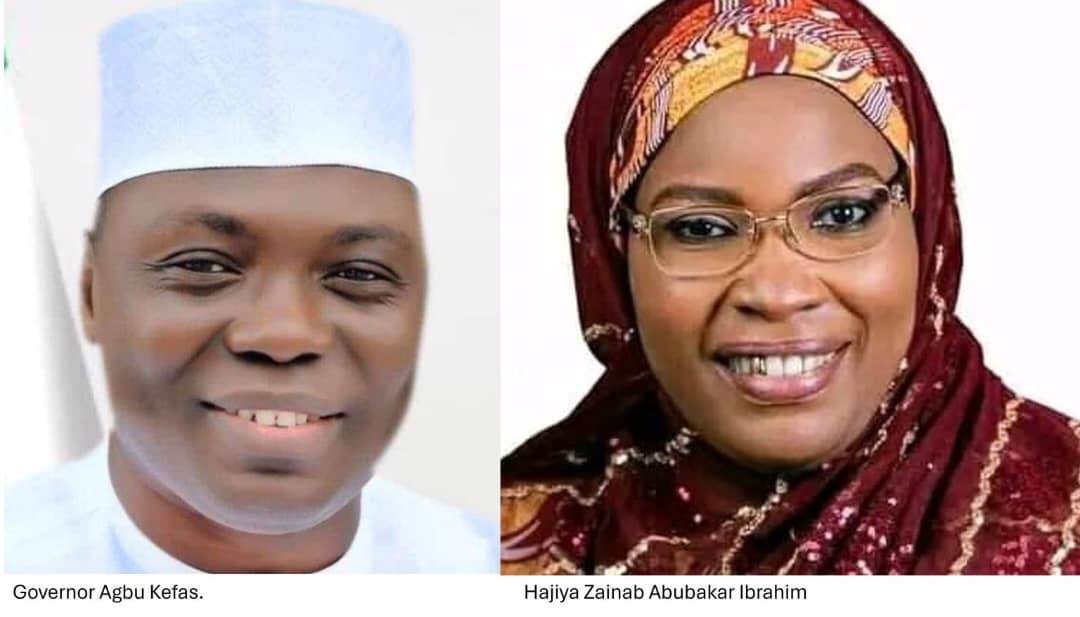
Taraba 2027: Why Zainab Ibrahim Could Reshape Kefas’ Re-election Calculations
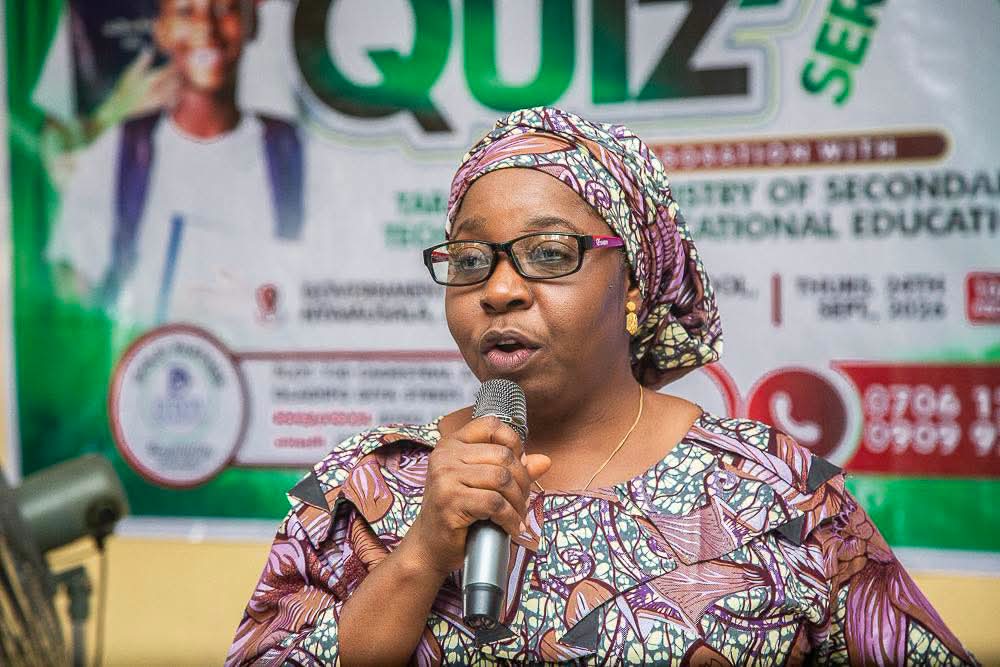
As Taraba State moves steadily towards the 2027 governorship election, the political calculations surrounding Governor Agbu Kefas are beginning to take clearer shape. One development attracting particular attention is the emergence of Hajiya Zainab Abubakar Ibrahim as his running mate.
Popularly known among supporters and associates as “Aunty Zee,” Ibrahim enters the contest with her own years of party experience, national exposure and grassroots mobilisation. But there is another dimension to her political story that cannot easily be separated from Taraba’s recent electoral history: she comes from a family whose name has already occupied a prominent place in the state’s politics.
Beyond the excitement surrounding the choice of a woman for the ticket, therefore, the bigger political question is what Aunty Zee brings to the Kefas re-election project and whether her emergence could alter the battle for Taraba in 2027.
More Than a Gender Statement
Selecting a woman as running mate naturally gives the ticket a strong gender-inclusion narrative. But reducing Ibrahim’s political value to gender alone would overlook the wider calculations surrounding her emergence.
As APC Deputy National Women Leader, she has operated within the party’s national structure and participated in political mobilisation beyond Taraba State. That experience potentially gives the Kefas ticket an important connection between the politics of Taraba and the national machinery of the ruling party.
For Kefas, having an established party figure beside him could also help strengthen relationships with longstanding APC members and structures.
That may become particularly important as the party attempts to manage competing interests ahead of the election.
Aunty Zee and the Mama Taraba Political Legacy
There is also an intriguing family dimension to Zainab Ibrahim’s emergence.
Aunty Zee is the younger sister of the late Senator Aisha Jummai Alhassan, popularly known as Mama Taraba, one of the most consequential female politicians Taraba State has produced.
For anyone familiar with the political history of Taraba, Mama Taraba requires little introduction.
She served in the Senate and later became Nigeria’s Minister of Women Affairs under President Muhammadu Buhari. But it was her extraordinary political following at home that turned her into a household name and one of the dominant personalities in Taraba politics.
Her rise was remarkable.
She demonstrated her electoral strength by winning election to the Senate in a political environment dominated by established male politicians and powerful political structures.
But perhaps the greatest demonstration of her political weight came during the 2015 Taraba governorship election, when she contested on the platform of the APC against Darius Ishaku of the PDP.
What followed became one of the most dramatic governorship contests in Taraba’s political history.
For much of the contest, Mama Taraba remained within striking distance of making history as Nigeria’s first elected female governor. The eventual outcome was shaped by fierce voting patterns across the state, including the decisive numbers from the Gembu/Sardauna axis.
The full story of Gembu and the final electoral arithmetic of that historic contest is perhaps a story for another day.
What cannot be disputed, however, is the political lesson that emerged from that election: Aisha Jummai Alhassan was a political heavyweight capable of building a formidable electoral coalition across Taraba.
Years after her death, the name Mama Taraba still carries political memories among many voters, particularly women and grassroots supporters who identified strongly with her political movement.
That history inevitably makes Aunty Zee’s emergence even more interesting.
Can Aunty Zee Inherit the Mama Taraba Constituency?
This may become one of the fascinating questions of the 2027 campaign.
Political influence is not automatically inherited, and Zainab Ibrahim will ultimately have to be judged on her own record, networks and ability to mobilise voters.
But political families often retain relationships, loyalties and emotional connections long after their most prominent figures leave the stage.
There are people across Taraba who worked with Mama Taraba, campaigned for her, voted for her or regarded her as a symbol of women’s political advancement.
Aunty Zee potentially enters the 2027 race with access to some of those historical relationships while simultaneously possessing political networks of her own.
The APC could therefore attempt to reconnect the old Mama Taraba political constituency with the emerging Kefas political structure.
If successfully achieved, that would give her nomination significance far beyond simply having a female running mate.
Bridging Old and New APC Forces
One of the challenges confronting any governor entering a new political party is integrating existing party stakeholders with supporters arriving alongside the governor.
Taraba’s APC contains politicians with long-established structures, ambitions and loyalties. The arrival of Kefas and his political network inevitably changes that internal balance.
Ibrahim could therefore become an important bridge.
Her longstanding roots within the APC give her credibility among sections of the party that existed before the governor’s arrival, while her position on the governorship ticket places her firmly within the emerging Kefas political structure.
Her family history also connects her symbolically to an important era in the development of opposition politics in Taraba.
If successfully managed, that combination could help bring together political tendencies that might otherwise compete for influence within the APC.
But political balance on paper does not automatically translate into electoral harmony. The real test will be whether influential stakeholders who lose out in the distribution of tickets and positions remain committed to the party.
The Women Vote
There is also the potentially significant question of women’s political mobilisation.
Women constitute a substantial segment of voters and grassroots political organisers across Taraba. Yet their representation at the highest levels of elective politics has remained limited.
This is another area where memories of Mama Taraba could become politically relevant.
Her governorship campaign demonstrated the potential of a strong female political figure to generate enthusiasm among women across social and economic backgrounds.
Aunty Zee’s emergence provides the APC with an opportunity to revive some of that enthusiasm while developing a political identity suited to the present contest.
Her position as APC Deputy National Women Leader has already placed women’s mobilisation at the centre of her political activities.
If effectively organised, women groups, market associations, professional women, rural organisations and female party structures could become an important mobilisation bloc for the Kefas-Ibrahim ticket.
Whether symbolism translates into votes, however, will depend on whether the campaign convinces women that their interests would receive meaningful attention in government.
She Must Build Her Own Political Identity
The Mama Taraba connection is politically valuable, but it also creates a challenge.
Aunty Zee cannot campaign simply as the younger sister of a political legend.
She must establish why Zainab Ibrahim herself deserves the confidence of Taraba voters.
Her years in party administration, women mobilisation, humanitarian activities and grassroots politics provide a foundation for that argument.
The challenge ahead is to transform those experiences into a distinctive statewide political identity.
If she succeeds, the Mama Taraba legacy becomes an additional advantage rather than the principal explanation for her relevance.
A Different Political Temperament
Another feature of Ibrahim’s political profile is her relatively restrained public style.
Taraba politics can be highly competitive, particularly during governorship contests. Personal attacks, defections, internal rivalries and aggressive rhetoric frequently become part of the campaign environment.
Ibrahim has generally cultivated a less confrontational image, emphasising party organisation, inclusion and engagement.
That approach could complement Kefas politically.
A running mate is not merely expected to campaign. The person may also be required to negotiate with aggrieved stakeholders, engage communities, mobilise party structures and help manage internal disagreements.
Her effectiveness in those areas could ultimately matter more than the ceremonial visibility associated with the position.
National Connections Meet Local Politics
Her position within the national APC structure adds another dimension.
The 2027 Taraba governorship election will not take place in isolation from national politics. Relationships with national party leaders and coordination between state and national campaign structures could influence the political environment.
Having a running mate already familiar with the party’s national leadership may therefore offer organisational advantages.
But national connections and family legacy alone cannot guarantee victory.
Taraba voters are likely to judge the Kefas ticket principally on issues closer to home: roads, education, healthcare, jobs, agriculture, security, workers’ welfare and the overall performance of the administration.
The Performance Question Remains
No running mate, regardless of political experience, family history or popularity, can completely remove the central question confronting an incumbent seeking another mandate:
What has the administration delivered?
As the campaign develops, Kefas’ record in office is expected to come under increasingly intense scrutiny.
The opposition will likely focus on government revenue, infrastructure, public expenditure and whether communities across Taraba have experienced sufficient improvement under the administration.
The APC, on the other hand, will seek to highlight areas where it believes the administration has made progress.
Ibrahim therefore joins a ticket whose electoral prospects will depend not only on political mobilisation but also on how successfully the administration can defend its record before voters.
2027 Will Provide the Verdict
The emergence of Aunty Zee has undoubtedly introduced another dimension into Taraba’s 2027 governorship contest.
She brings her own experience in national party administration, women’s mobilisation and grassroots politics.
She also carries a family name permanently associated with one of the most remarkable political movements in Taraba’s recent history.
But 2027 will determine whether the old political affection associated with Mama Taraba can intersect with Aunty Zee’s own networks and the political machinery of an incumbent governor.
For Zainab Ibrahim, this is an opportunity to move from being recognised principally as a national party leader and the younger sister of a Taraba political icon to establishing a statewide electoral identity of her own.
For Kefas, her selection could represent an attempt to combine incumbency, established APC structures, women mobilisation and one of Taraba’s most recognisable political legacies on a single ticket.
Whether that calculation succeeds will ultimately be decided by Taraba voters.
And as those familiar with the 2015 governorship contest will remember, in Taraba politics, sometimes the final numbers can tell a very different story from the one everyone expected.