
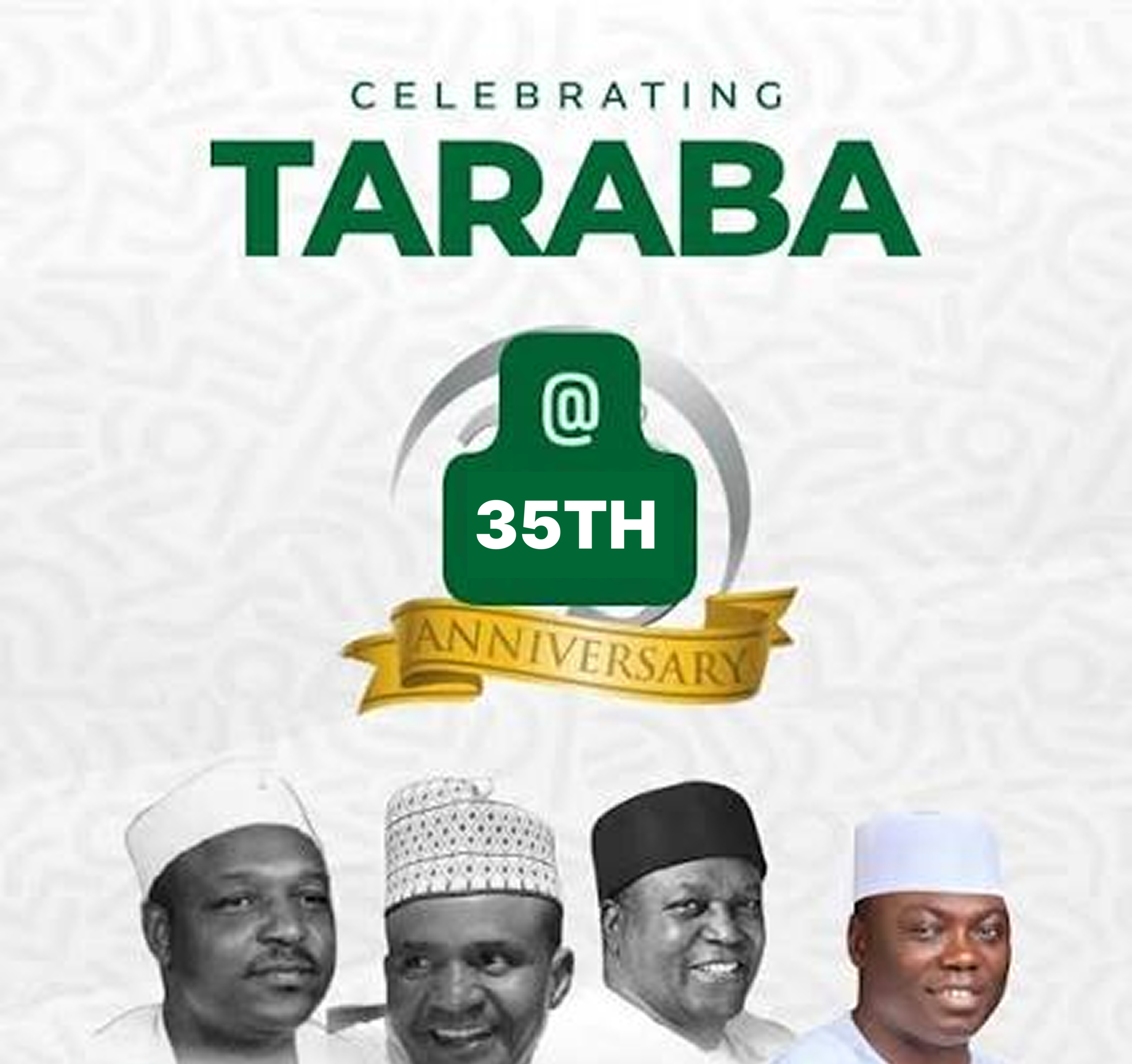
TARABA AT 35: A Gift Still Waiting To Be Unwrapped
By Frank Prince Garriba
Thirty-five years is a long time in the life of a state. Since its creation on August 27, 1991, Taraba has produced governors, ministers, legislators, academics, entrepreneurs, and professionals of national and international standing. Jalingo has grown, institutions have expanded, and successive governments have implemented numerous development projects.
Yet, at 35, Taraba must confront an uncomfortable question: how much of its enormous potential has been converted into prosperity for its people?
The answer is mixed. Taraba remains one of Nigeria’s most naturally endowed states. Its fertile agricultural land, rivers, forests, mineral resources, Mambilla Plateau, Gashaka-Gumti National Park, and proximity to Cameroon offer enormous opportunities in agriculture, tourism, mining, renewable energy and trade.
But the paradox is glaring: Taraba has the resources of a potentially prosperous state but has struggled to transform those resources into industries, jobs, and sustainable revenue.
Successive administrations deserve credit for investments in roads, education, healthcare, agriculture and public institutions. However, development has often been fragmented, with projects and policies changing with governments. Too many initiatives lack continuity, strong monitoring, and measurable outcomes.
Infrastructure remains a major constraint. Poor rural roads limit agricultural production and market access, while inadequate electricity, water, and other basic infrastructure discourage industrialisation. Education has received some attention and expanded, but quality, teacher shortages and skills development remain major concerns. Healthcare access, particularly in rural communities, also needs serious improvement.
Security is another major challenge. Communal conflicts, farmer-herder tensions, land disputes, and kidnapping have displaced communities, destroyed livelihoods, and discouraged investment. Peace, therefore, must be treated not merely as a security issue but as an economic necessity.
Politics is equally important. Taraba’s politics has historically been highly competitive, but ethnic and sectional considerations sometimes overshadow issues of development. The recent political realignment under Governor Agbu Kefas has altered the state’s political landscape, but the real challenge is to make politics about performance rather than patronage.
Who is responsible for Taraba’s shortcomings? Governors and governments bear primary responsibility, but they are not alone. The legislature, local governments, political elite, traditional institutions, business community, civil society, media, and citizens all have roles to play. Citizens must also reject the culture of selling votes for short-term benefits.
The way forward is clear.
Taraba must develop a long-term development plan that survives changes in government. Agriculture should move from raw production to processing and agro-industry. The Mambilla Plateau and other tourist assets should be developed sustainably. Mining must be properly regulated. Roads and electricity should be treated as economic infrastructure. Education should focus more on skills, science, technology, and entrepreneurship. Above all, the state must strengthen accountability, peacebuilding, and revenue generation.
At 35, Taraba’s greatest asset remains its people and its extraordinary natural endowment. Its greatest weakness is the failure to fully convert these assets into broad-based prosperity. The state is not a failure. It is a state of immense promise that has yet to fulfil its promise.
Thirty-five should therefore be more than a birthday celebration. It should be a moment of honest reflection and a declaration that Taraba’s next 35 years must be about turning Nature’s Gift into Nigeria’s growth engine.
Keep targeting the big stories – the issues that hinge on the people’s yearnings. TARABA NEWS must always be out to serve and celebrate the people, hold leaders accountable, and focus on the development, peace, and security of Taraba State.