



Appellant files 28 grounds of appeal, seeks to overturn Federal High Court ruling affirming Taraba APC congress
TARABA NEWS
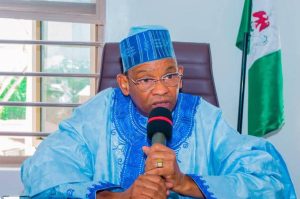
Hon. Abdulhadi Haruna Lau has approached the Court of Appeal, Yola Judicial Division, challenging the judgment of the Federal High Court in Jalingo which dismissed his suit against the All Progressives Congress (APC) and its Taraba State Chairman, Alhaji Abubakar Bawa.
In a Notice of Appeal dated November 23, 2026, Lau expressed dissatisfaction with the judgment delivered on November 18, 2026, by Justice Mashkur Salisu in Suit No. FHC/JAL/CS/5/2026.
The appellant is challenging the entire judgment of the lower court, which dismissed his suit questioning the conduct and outcome of the APC’s March 3, 2026 State Congress that produced Abubakar Bawa as the party’s State Chairman alongside other members of the State Working Committee.
The Notice of Appeal contains 28 grounds of appeal, through which Lau is seeking to overturn the findings and conclusions reached by the Federal High Court.
Among the major issues raised is the argument that the trial court wrongly entertained preliminary objections filed by the defendants despite what the appellant described as contentious factual issues that required proper examination during the substantive hearing.
Lau is also challenging the court’s interpretation of the internal dispute-resolution provisions of the APC Constitution, arguing that his complaints to the party’s National Chairman should have been given proper consideration, particularly in view of his allegation that the party failed to act on his grievances.
On the question of jurisdiction, the appellant argues that his case went beyond an ordinary internal leadership dispute, maintaining that it raised issues bordering on alleged violations of constitutional and statutory provisions governing democratic participation in political party congresses.
Specifically, he is challenging the trial court’s interpretation and application of Sections 223(1)(a) and 224 of the 1999 Constitution, as well as Sections 82 and 83 of the Electoral Act, 2026, which he relies upon in questioning the democratic conduct and legality of the party congress.
Another significant aspect of the appeal concerns the non-issuance of Expression of Interest and Nomination Forms to Lau before the March 3 congress.
According to the grounds of appeal, the trial judge acknowledged that the APC did not issue the relevant forms to him but held that the evidence presented did not establish an unconditional legal entitlement to the forms.
Lau is contesting that conclusion, arguing that the court failed to properly evaluate the payment acknowledgement, his membership dues and other documentary evidence presented in support of his claim.
He is equally challenging the court’s findings regarding his financial standing as an APC member, the alleged suspension of his membership rights and the party’s acceptance of his outstanding membership dues.
The appellant contends that the acceptance of his payments and the issuance of an acknowledgement by the party should have been properly considered in determining his membership rights and eligibility to participate in the congress.
Furthermore, Lau is questioning the court’s conclusion that he failed to establish that the congress adopted or enforced an unlawful consensus arrangement or violated specific provisions governing the conduct of the party’s internal elections.
He also argues that the trial court failed to adequately consider the evidential implications of the absence of certain congress documents, including the minutes, delegates’ list, screening report, result sheet and INEC monitoring report, which he maintains were relevant to determining the legality of the process.
In another ground of appeal, Lau challenges the trial court’s position that the completion of the congress could not independently rescue his case, arguing that the legality of a completed political process and its consequential effects remain matters capable of judicial determination.
The appeal lists three respondents: the All Progressives Congress (APC) as the first respondent, the Independent National Electoral Commission (INEC) as the second respondent, and Alhaji Abubakar Bawa as the third respondent.
In the reliefs sought, Lau is asking the Court of Appeal to allow the appeal, set aside the judgment of the Federal High Court and grant the reliefs contained in his amended originating summons.
The development follows the November 18 judgment in which the Federal High Court dismissed his suit, holding, among other things, that he failed to exhaust the internal dispute-resolution mechanisms provided by the APC Constitution.
The court further held that he did not establish the necessary legal grounds to invalidate the congress or demonstrate an enforceable entitlement to the nomination forms.
Although the court acknowledged that the APC did not issue the forms to Lau, it ruled that the evidence before it did not establish that he had satisfied all the requirements for obtaining them.
The court subsequently dismissed the suit in its entirety and awarded ₦1 million in costs against the plaintiff in favour of the APC and another ₦1 million in favour of Abubakar Bawa, bringing the total cost award to ₦2 million.
With the filing of the Notice of Appeal, the legal battle over the disputed APC Taraba State Congress has moved to the Court of Appeal, where Lau is seeking a reversal of the lower court’s decision.
The appeal is yet to be determined, and the November 18 judgment remains the decision of the Federal High Court pending any contrary determination by the appellate court.
TARABA NEWS