

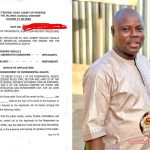

8 YEARS WITHOUT TRIAL: The Story of Peter Edward, Jalingo Prison’s Longest Awaiting-Trial Inmate
Arrested in 2018 over alleged murder, arraigned before different judges, yet no witness has testified as inmate asks: “When will my deliverance come?”
By Taraba News Investigative Desk
Eight years is a long time.
Eight years is enough for a child born in 2018 to grow, start school and advance several classes. It is enough for governments to come and go, careers to change and families to be transformed.
But for Peter Edward, eight years have reportedly passed behind the walls of the correctional facility in Jalingo while he waits for the criminal justice system to determine whether he is guilty or innocent of the allegation against him.
His story raises troubling questions about the administration of criminal justice in Taraba State and the fate of awaiting-trial inmates who can spend years in custody before their cases are determined.
Peter was arrested on April 15, 2018, at Fali, Baissa, in Kurmi Local Government Area of Taraba State, over an allegation of murder.
According to Peter’s account to Taraba News, he was working in the forest, where he was engaged in woodwork, when he was arrested.
More disturbing is his claim that he did not even know the person he was accused of murdering.
Yet that arrest marked the beginning of a journey that, eight years later, has still not produced a concluded trial.
Arrested Alongside Others — But Only Peter Remained
Peter said about five other persons were named in connection with the alleged offence.
According to him, the police were unable to arrest the other accused persons. He further claimed that parents or relatives of some of those accused were subsequently brought to the Criminal Investigation Department following his arrest but were eventually released on bail.
Peter remained in custody.
From that moment, freedom gradually became a distant memory.
He was subsequently arraigned before a Magistrate Court in Jalingo. Because the allegation involved murder, the substantive prosecution would ultimately have to proceed before a court with jurisdiction to try the offence.
Then began the waiting.
Three Years Waiting for DPP Advice
According to information obtained by Taraba News, Peter remained in custody for approximately three years while awaiting legal advice from the Department of Public Prosecutions (DPP).
Eventually, the matter proceeded to the Taraba State High Court and was assigned to the late Justice Isa Sambo.
For Peter, it should have marked the beginning of an opportunity to finally confront the allegation against him.
But fate intervened.
Justice Sambo died before the case could substantially progress.
The death of the judge created another chapter of uncertainty.
According to Peter and information available to Taraba News, for about two years following the death of Justice Sambo, Peter did not return to court for his substantive trial.
He remained in custody.
Days became weeks.
Weeks became months.
Months became years.
And the central question remained unanswered:
Did Peter Edward commit the crime for which he had lost his freedom?
Eight years after his arrest, that question has reportedly still not been judicially determined.
From One Judge to Another
Following the prolonged delay, the case was eventually reassigned to another judge.
Peter was reportedly arraigned afresh and again pleaded not guilty.
But according to information gathered by Taraba News, the case did not proceed to substantive hearing before that judge.
Peter’s account is that the judge expressed concern that, being newly appointed and with the possibility of being transferred to Wukari, she might not be in a position to conclude the matter.
The case file was consequently returned for reassignment.
At the time, the late Justice Filibus Andetur was Chief Judge of Taraba State.
According to Peter’s lawyer, Barrister Dodo, the matter was subsequently assigned to another judge.
Once again, Peter appeared before the High Court.
Once again, the allegation was read to him.
And once again, he pleaded not guilty.
Still, the trial did not move forward.
This time, according to the account provided to Taraba News, there was another problem: while the court could locate documentation relating to Peter’s bail application, the substantive case file could reportedly not be located.
The matter was therefore expected to be referred back for administrative action and reassignment.
And Peter returned to custody.
Eight Years — No Witness
Perhaps the most disturbing aspect of Peter’s story is this:
According to the information available to Taraba News, not a single prosecution witness has testified against him in approximately eight years.
Peter has not been convicted.
His plea remains not guilty.
Yet his freedom has been taken away for almost eight years while the allegation against him remains unresolved.
The principle that an accused person is presumed innocent until proven guilty is fundamental to criminal justice.
Peter is not asking the public to declare him innocent.
Neither should anyone declare him guilty without trial.
What he desperately needs is something far more basic:
A trial.
If the state has evidence that Peter committed murder, that evidence should be presented before a competent court and tested according to law.
If the prosecution cannot establish the allegation, the justice system must equally confront the implications of keeping a man incarcerated indefinitely.
The frightening question is therefore no longer simply whether Peter committed the alleged offence.
It is:
How can a man spend eight years awaiting the determination of an allegation when, according to the information available, no witness has even testified?
“When Will My Deliverance Come?”
Behind the legal terminology — DPP advice, reassignment, case files, arraignment and administrative procedures — is a human being.
Peter has a life.
He has a family.
He had work.
He had dreams.
For nearly eight years, according to his account, those things have been suspended.
Today, Peter does not know when his case will end.
He does not know when the next meaningful hearing will take place.
He does not know whether the system will ultimately convict him or set him free.
According to those familiar with his situation, the prolonged uncertainty has taken an enormous emotional toll.
After years of waiting, Peter’s question has become painfully simple:
“When will my deliverance come?”
It is a question that should trouble everyone responsible for the administration of justice.
8 Years Is Not 8 Days
Taraba News is therefore calling on the Chief Judge of Taraba State, Justice Joel Agya, to take a special interest in Peter Edward’s case and ensure that whatever administrative obstacles have prevented the matter from proceeding are urgently addressed.
Eight years is not eight days.
A murder allegation is extremely serious. The family of any alleged victim is entitled to justice.
But an accused person is also entitled to have the allegation against him determined through a fair and reasonably prompt judicial process.
Justice must work for both sides.
If Peter is guilty, why has the state been unable to establish that guilt before a court after all these years?
If he is innocent, who gives him back eight years of his life?
And if administrative failures, missing files, repeated reassignments or other institutional problems are responsible for the delay, who takes responsibility?
These questions deserve answers.
Peter May Be Only One Among Many
Even more worrying is that Peter’s case may not be an isolated one.
A Taraba News investigation into awaiting-trial detention at the Jalingo correctional facility indicates that there are other inmates who have reportedly spent two, three, five, six and even seven years awaiting the conclusion of their cases.
Peter’s situation attracted particular attention because information available to this newspaper suggests that he may be among the longest-serving awaiting-trial inmates at the facility.
That should trigger a wider examination of the criminal justice system in Taraba State.
How many inmates are awaiting trial?
How many have spent more than one year in custody?
How many have spent more than five years?
How many cases have stalled because of missing files, judicial transfers, death or retirement of judges, delayed legal advice or inability to produce defendants in court?
And how many people remain behind bars without knowing when the evidence against them will finally be heard?
These are not merely statistics.
Behind every number is a human life.
A Call to the Human Rights Community
Taraba News calls on human-rights lawyers, the National Human Rights Commission, civil-society organisations and other organisations concerned with access to justice to examine Peter Edward’s case and the broader situation of prolonged awaiting-trial detention in Taraba State.
This intervention should not be about declaring Peter innocent or guilty.
That responsibility belongs to the court.
It should be about ensuring that Peter finally gets his day in court.
The prosecution should be allowed to present its case.
Peter should be allowed to defend himself.
Witnesses should testify.
Evidence should be examined.
And a court should decide.
That is what justice requires.
Peter Edward has waited since April 15, 2018.
Nearly eight years later, according to the information gathered by Taraba News, the prosecution has yet to call a single witness.
Every night Peter spends behind bars adds another day to a question the justice system can no longer afford to ignore:
If Peter Edward is guilty, when will he be tried and convicted according to law?
If he is not guilty, how many more years must he lose before he walks free?
For Peter, justice is no longer an abstract legal principle.
It is eight years of his life.
And counting.