







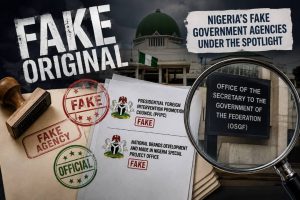
Fake Original: Nigeria’s ‘Agencies’ Under the Spotlights
Some years ago, I was travelling by road from Oyo State to Taraba State when I was stopped at a police checkpoint. As is customary, the officer requested the particulars of my vehicle.
I confidently presented everything I had: vehicle papers, Customs documents and other relevant particulars. As far as I was concerned, there was nothing to worry about. I had obtained the documents through what I believed was the proper channel and had no reason to doubt their authenticity.
The police officer carefully examined the documents. After a while, he looked at me and delivered a verdict I had never heard before:
“This Customs paper is fake original.”
I was shocked.
Fake original?
How could something be fake and original at the same time?
I asked him to explain. His explanation stayed with me.
According to the officer, the document looked original because it allegedly came through people connected to the same system that produced genuine documents. The paper, stamps and other features could therefore appear authentic to an ordinary person. What made it “fake”, he explained, was that the transaction had allegedly bypassed the lawful process.
In other words, it could look real, feel real and perhaps even survive casual inspection, yet something fundamental was missing: legitimacy.
Years later, as I follow the extraordinary controversy surrounding alleged fake federal government agencies operating within Nigeria’s bureaucracy, that encounter comes back to me.
Nigeria may now be confronting the institutional equivalent of the “fake original.”
From Fake Documents to Fake Government Offices
Two recent cases deserve serious national attention—not merely because the Independent Corrupt Practices and Other Related Offences Commission (ICPC) describes the entities involved as fake, but because of how deeply they allegedly penetrated the machinery of government.
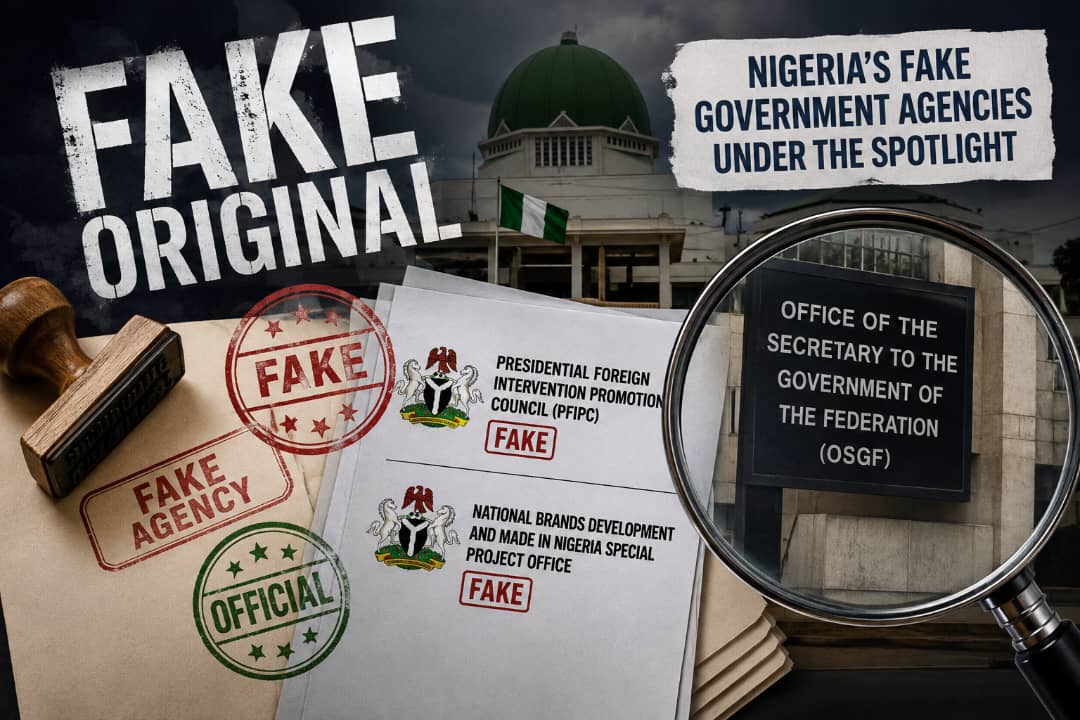
The first is the controversial Presidential Foreign Intervention Promotion Council (PFIPC).
The Presidency maintains that the council was not legally established. Yet reports indicate that it operated with many outward features one would normally associate with a government institution. The controversy became serious enough for President Bola Tinubu to order an investigation, while Chief of Staff Femi Gbajabiamila subsequently appeared before the ICPC and answered investigators’ questions. The ICPC stressed that he was not arrested and that the investigation remained ongoing.
The man associated with the disputed council, Adeniyi Adeyemi Matthew, has faced allegations of forgery and impersonation. He has denied wrongdoing and challenged the government’s account of how an organisation now described as fictitious could have apparently penetrated official structures.
The questions became even more troubling because a ₦1.3 billion allocation linked to the disputed council appeared in the 2026 federal budget, according to multiple reports. Investigations have also examined how an entity the Presidency says never legally existed could acquire other trappings associated with government.
That is precisely where my old expression comes back:
Fake original.
If something is completely fake and operating from somewhere outside government, the problem is easier to understand.
But what happens when an allegedly fake institution begins to acquire the appearance, access and recognition associated with the real government?
That is a much more dangerous problem.
Then Came Another One
Just when Nigerians might have assumed that the PFIPC controversy was an extraordinary one-off failure, the ICPC announced the discovery of another allegedly fictitious government office.
This time, the commission identified the National Brands Development and Made in Nigeria Special Project Office, which it said had been allocated office space within the premises of the Office of the Secretary to the Government of the Federation (OSGF) despite lacking legitimate status as a government establishment.
According to the ICPC, the organisation was promoted by George Buchi Nwabueze, whom the commission said had operated under variations of his name.
Following the discovery, President Tinubu suspended three permanent secretaries as investigations into procedural weaknesses in the public service widened.
The significance is difficult to overstate.
We are no longer talking simply about someone printing a fake letterhead somewhere in Lagos, Kano or Onitsha and claiming to represent the Federal Government.
The disturbing allegation is that an unauthorised body obtained space within the premises of one of the most important coordinating offices of the Federal Government.
How?
That is the question Nigeria must answer.
How Does a Fake Agency Become This Real?
This should not primarily become another partisan contest between supporters and opponents of the Tinubu administration.
The deeper issue is institutional.
How does an organisation that has not been lawfully established get sufficiently far inside government bureaucracy to appear legitimate?
Who verifies the creation of government agencies?
Who allocates office accommodation?
Who verifies appointment letters?
Who authorises recruitment?
Who gives institutions access to government facilities?
Who ensures that an agency appearing in official documentation actually has the legal instrument establishing it?
And perhaps most importantly: how many checkpoints must fail before a fake institution begins to function like a real one?
These questions become more urgent when we consider the PFIPC case. Investigative reporting found that the disputed organisation appeared to have crossed several layers of the federal bureaucracy before the controversy exploded publicly.
The second case therefore changes the conversation.
One fake agency could perhaps be dismissed as an extraordinary fraud perpetrated by unusually sophisticated individuals.
Two cases suggest that government must examine the system itself.
The “Fake Original” Problem
This brings me back to that police officer many years ago.
His phrase was humorous, but the principle behind it was profound.
The greatest danger may not be the crude fake that everybody can identify.
The greater danger is the fake that obtains enough genuine characteristics to become almost indistinguishable from the original.
A fake police officer wearing ordinary clothes may quickly attract suspicion. But give him a genuine-looking uniform, an office inside a police formation, official correspondence and access to government systems, and ordinary citizens will naturally assume that he is legitimate.
The same principle applies to institutions.
If an organisation has an impressive government name, operates from government premises, communicates with public institutions and finds its way into official processes, how is an ordinary Nigerian—or even a foreign investor—expected to know that it is not genuine?
Government legitimacy rests partly on public trust in official symbols.
Once those symbols can be acquired or manipulated without adequate verification, the problem extends far beyond corruption. It becomes a national security, investment and governance risk.
But We Must Be Fair
There is also a need for caution.
An investigation is not a conviction.
The PFIPC matter involves competing claims, criminal proceedings and an ongoing anti-corruption investigation. Allegations involving public officials should therefore not be presented as established guilt where investigations have not reached that conclusion.
Gbajabiamila has denied wrongdoing, and his lawyer confirmed that he cooperated with the ICPC investigation. The Presidency has maintained that documents purportedly linking his office to the establishment of the disputed council were forged.
Similarly, suspending permanent secretaries in connection with the second discovery should not automatically be interpreted as proof that they personally created or knowingly supported a fake agency. The investigation must establish individual responsibility.
Objectivity demands that distinction.
But objectivity also requires us not to ignore the institutional failure simply because individual culpability remains under investigation.
Somebody may ultimately be innocent of corruption and yet the administrative system may still have failed catastrophically.
Tinubu Has an Opportunity
President Bola Tinubu deserves credit for directing investigations rather than allowing the controversies to disappear quietly.
But investigation should be the beginning, not the end.
Nigeria needs a comprehensive audit of federal ministries, departments, agencies, councils, committees, special project offices and presidential initiatives.
Every government institution should be traceable to a clear legal or executive authority establishing it.
There should be a central digital register through which any Nigerian, company, foreign embassy, investor or government institution can confirm within minutes whether an agency exists, the instrument establishing it, its supervising authority, leadership and official contact information.
The Federal Government should also investigate the administrative pathways exposed by these cases: office allocation, appointment verification, budget preparation, personnel documentation, official correspondence and inter-agency recognition.
The objective should not merely be to find the individuals behind two questionable organisations.
It should be to make a third one virtually impossible.
Beyond Two Fake Agencies
There is an even bigger question.
If the ICPC could uncover two allegedly fake government bodies with connections to highly sensitive federal administrative environments, are there others?
Nobody should assume there are. But government should equally not assume there are not.
That question can only be settled through a systematic audit.
Nigeria cannot afford a situation where citizens must begin to wonder whether every unfamiliar government agency they encounter is genuine.
A government institution should not require investigative journalism or an ICPC investigation before its legitimacy can be established.
The Lesson From My Journey
Many years after that journey from Oyo to Taraba, I finally understand why the policeman’s strange expression stayed with me.
“Fake original.”
Perhaps he was describing more than my vehicle document.
He was describing one of the most dangerous forms of institutional corruption: when the illegitimate becomes so embedded in legitimate structures that the ordinary person can no longer tell the difference.
The current investigations provide Nigeria with an opportunity to close those gaps.
The country should take it.
Because when a fake document carries the appearance of the original, one citizen may suffer.
But when a fake institution acquires the appearance and machinery of government, an entire nation is at risk of being deceived.
Olayinka Gabriel is a public affairs analyst based in Jalingo.