


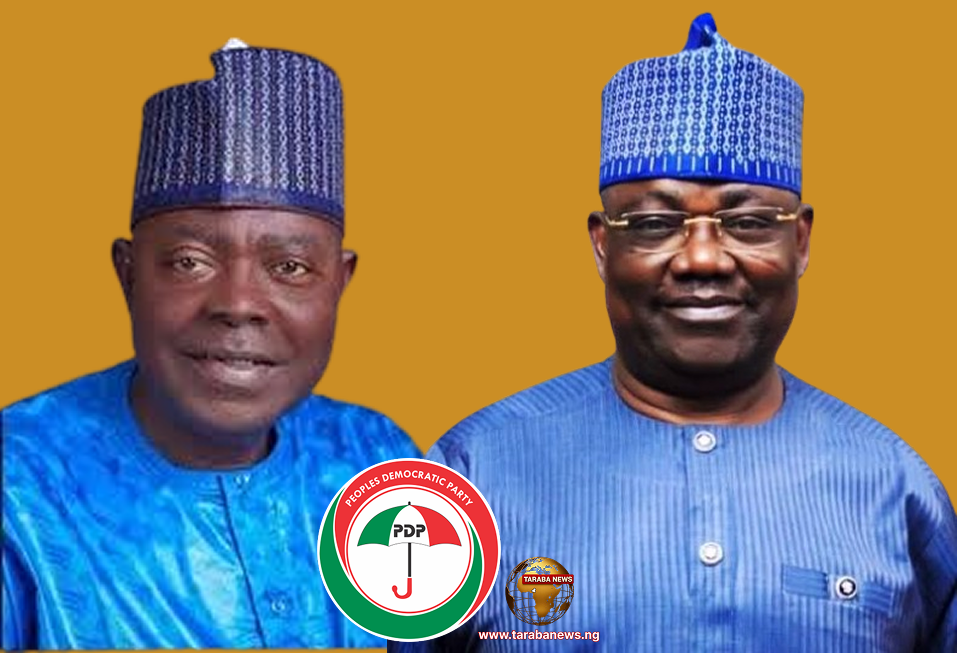
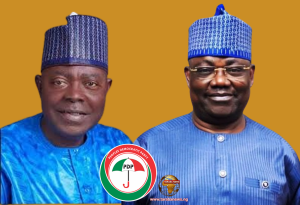
The battle for the 2027 governorship ticket of the Peoples Democratic Party (PDP) in Taraba State has entered a more complicated phase, with the emergence of two competing candidates and a widening legal dispute over the authority of the party structure that produced them.
At the centre of the contest are Senator Emmanuel Bwacha and Senator Joel Danlami Ikenya, whose emergence from separate PDP primary processes has exposed the depth of the crisis within the opposition party in Taraba.
The controversy has now acquired a fresh legal dimension following the recent Court of Appeal judgment on the PDP’s governorship candidate in Osun State, a decision that has renewed debate over what ultimately makes a political party’s candidate legally valid.
For Taraba, the question is no longer merely who won a primary.
It is increasingly about which party structure had the lawful authority to conduct that primary in the first place.
The Osun verdict and why it matters
The Court of Appeal’s recent decision concerning the PDP’s governorship candidate in Osun State has become a significant reference point in the unfolding Taraba controversy.
The appellate court upheld the nomination of the PDP’s Osun governorship candidate, after considering the process through which the candidate emerged and the circumstances surrounding the party’s submission of his name to the Independent National Electoral Commission (INEC).
The decision has generated competing political interpretations, but one important lesson stands out: the validity of a candidate’s nomination ultimately depends on the legality of the process through which that candidate emerged.
The Osun judgment should, however, not be misrepresented as a blanket judicial recognition of one faction of the PDP’s national leadership.
Its relevance to Taraba is more specific.
It demonstrates that where the validity of a party candidate is challenged, the court may be required to examine the process behind the nomination rather than simply the existence of the candidate’s name on an electoral platform.
That distinction could become crucial in Taraba.
Two candidates, one ticket
The Taraba PDP now has two prominent governorship claims.
Senator Emmanuel Bwacha emerged from a primary conducted under the party structure associated with the Wike-backed faction of the PDP.
Senator Joel Danlami Ikenya, on the other hand, emerged from a separate primary conducted by the faction led by PDP National Chairman Tanimu Turaki, SAN, through the Taraba State leadership headed by Obidah J. Bitrus.
Both camps regard their respective processes as legitimate.
Both have political structures behind them.
And both are positioning their candidate as the authentic PDP flag bearer for the 2027 governorship election.
But only one candidate can ultimately carry the PDP ticket into the election.
That is why the question of party authority has become more important than the competing claims of political strength.
Bwacha’s case
Bwacha’s camp points to the governorship primary through which he emerged and the involvement of the Taraba PDP structure aligned with the Wike-backed national faction.
His supporters argue that the exercise represented the legitimate PDP nomination process in the state and that Bwacha consequently emerged as the authentic candidate of the party.
Bwacha has since intensified his political activities and has presented himself as the PDP candidate prepared to challenge the incumbent administration in 2027.
But the existence of a primary and the declaration of a winner do not, in themselves, end the legal conversation.
The critical question is whether the structure that conducted the exercise had the necessary authority to do so.
That question cannot be separated from the larger leadership dispute within the PDP.
Ikenya’s case
Ikenya’s candidacy is built on a different foundation.
He emerged from the primary organised by the Turaki-led faction, which regards itself as the legitimate national leadership of the PDP.
His supporters therefore contend that the primary was conducted under the authority of the authentic party leadership and that Ikenya is consequently the legitimate PDP candidate for Taraba.
The argument is straightforward: if the Turaki-led structure is recognised as the lawful authority of the party, then the nomination process conducted under its supervision gains significant legal weight.
But that argument also has a corresponding vulnerability.
If a court ultimately determines that the structure did not possess the authority claimed by its supporters, questions could arise over the validity of the primary and the nomination arising from it.
Thus, Ikenya’s political fortunes are closely connected to the legal status of the structure that produced him.
What about the INEC portal?
This is perhaps the most misunderstood part of the controversy.
Political actors and supporters often speak as though the appearance of a candidate’s name on the INEC platform automatically settles the question of who the legitimate candidate is.
It does not necessarily work that way.
INEC administers the electoral process and receives candidate nominations from political parties.
It does not conduct political party primaries.
It does not create party leadership structures.
And it does not substitute for the courts when there is a fundamental dispute over the authority of the body that nominated a candidate.
Therefore, even if a candidate’s name appears on the INEC portal, the deeper legal question may remain:
Was the candidate validly nominated by the party structure legally entitled to make that nomination?
That is the question that could ultimately determine the Taraba PDP ticket.
The Osun lesson for Taraba
The Osun judgment is important precisely because it brings attention back to the nomination process.
The court’s consideration of the circumstances surrounding the PDP’s Osun nomination illustrates why political parties cannot simply assume that an announcement or electronic submission will settle every dispute.
Where there is no serious dispute over the authority of the party structure that conducted a primary, the legal pathway may be considerably clearer.
Taraba is different.
Here, there are competing party structures and competing primaries.
That makes the issue substantially more complicated.
The question is not simply whether Bwacha won his primary or whether Ikenya won his.
The question is which primary was authorised by the legally recognised structure of the PDP.
Wike versus Turaki: the national crisis enters Taraba
The Taraba dispute cannot be understood in isolation from the national PDP crisis.
Bwacha is associated with the Wike-backed faction, while Ikenya emerged through the Turaki-led faction.
The state governorship ticket has therefore become an extension of the larger struggle over who controls the PDP’s national machinery.
This has transformed what would ordinarily have been an internal contest among aspirants into a dispute over institutional authority.
The danger is that the Taraba PDP could find itself entering a general election campaign while still litigating over its own candidate.
That would be politically costly.
Can the INEC server decide the matter?
The short answer is no — not by itself.
The server can reflect what has been submitted to INEC.
It cannot determine the constitutional validity of the party structure that made the submission.
This is why the argument should not be framed as simply “whose name is on the server?”
The more important question is:
“Who had the lawful authority to put that name there?”
That distinction is at the heart of the Taraba dispute.
A difficult road ahead
For both Bwacha and Ikenya, the road ahead therefore involves more than political mobilisation.
Bwacha must defend the legal foundation of the process that produced him.
Ikenya must equally defend the authority of the structure that conducted the primary through which he emerged.
Neither side can afford to assume that political momentum alone will settle the matter.
The courts could ultimately become the arena where the competing claims are tested.
And if that happens, the arguments will likely revolve around the PDP constitution, the Electoral Act, the authority of the relevant party organs, the conduct of the competing primaries and the recognition of the respective party structures.
What does this mean for the PDP?
The PDP faces a strategic dilemma.
If the dispute remains unresolved, the party risks entering the 2027 election with competing campaign structures, conflicting messages and a divided support base.
Rather than presenting a united challenge to the incumbent, the party could spend valuable political capital fighting over its own ticket.
That is precisely why the leadership of the party and stakeholders in Taraba have a strong incentive to seek a definitive resolution.
A candidate whose nomination is constantly challenged may struggle to campaign with the confidence required for a serious governorship contest.
Beyond Bwacha and Ikenya
There is also a broader question that Taraba voters should consider.
The 2027 governorship election should ultimately be about the candidates’ programmes and their capacity to govern.
Questions of infrastructure, security, education, healthcare, agriculture, employment, investment and the management of public resources should not be overshadowed indefinitely by party disputes.
But before voters can compare Bwacha and Ikenya on those issues under the PDP platform, the party must first resolve who is legally entitled to carry its flag.
The question that remains
The Osun judgment does not automatically make Bwacha valid.
Neither does it automatically make Ikenya valid.
It does, however, reinforce the importance of the process through which a candidate emerges.
For Taraba PDP, the decisive questions remain:
Which faction had the lawful authority to conduct the governorship primary?
Which party structure was legally recognised for the purpose of nomination?
Were the relevant electoral and party rules followed?
And can the resulting nomination survive judicial scrutiny?
Until those questions are settled, the Taraba PDP ticket remains more than a contest between two politicians.
It is a contest over party authority, legal legitimacy and political control.
Bwacha or Ikenya?
The answer may ultimately not be determined by who has the louder political machinery or whose name appears first on a database.
It may be determined by something much less political and far more decisive: